
Last Updated: November 23, 2026
Quick Summary
Your window shutters need professional repair when they make grinding, scraping or clunking noises, stick or jam halfway, fail to close properly, or show cracked louvres and loose hinges. Any change in how they open, close or lock is worth investigating before a small fault becomes a costly one.
- A single squeak is rarely urgent, but grinding plus a panel that no longer sits flush points to misalignment.
- On track systems, sticking is almost always debris, a bent track, or a worn roller or glide.
- Three or more ticks on the repair checklist point towards repair rather than replacement.
- Stop using a shutter immediately if fixings have pulled out of the wall or the frame moves when operated.
- Check hinges and fixings twice a year and touch up chipped finish before moisture reaches the timber.
Table of Contents
- How do I know if my window shutters need repairing?
- How to fix sticking window shutters
- Broken shutter louvre repair: what can be fixed
- Window shutter repair or replacement: how to decide
- Wooden shutter maintenance that prevents costly repairs
- Safety risks and when to stop using your shutters
- Book a free home visit to assess your shutters
- Frequently Asked Questions
How do I know if my window shutters need repairing?
You know your window shutters need professional repair when they make grinding, scraping or clunking noises, stick or jam halfway, fail to close properly, or show cracked louvres and loose hinges.
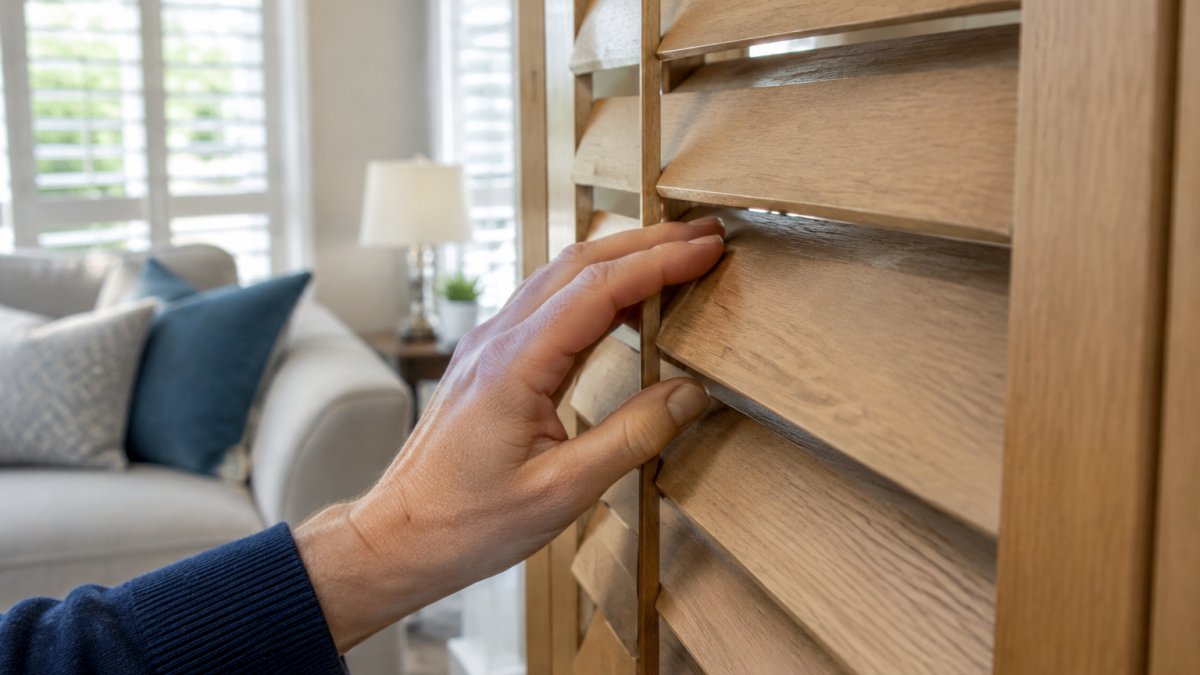
Shutters are simple mechanisms, and the faults that show up on them tend to follow a recognisable pattern: problems caught early are usually cheaper to put right than those left to worsen.
Below, we walk through the warning signs, what each one usually means, and how to tell a five-minute fix from a job that needs a professional.
Noises that signal a problem
Sound is the first warning sign most people notice. A healthy shutter opens and closes almost silently. New noises mean something has shifted.
- Grinding or scraping: the panel is rubbing against the frame or the tracks are worn.
- Clicking: a loose hinge pin or a tilt rod that has come adrift.
- Rattling: loose staples, pins or fixings in the louvre assembly.
- Squeaking: dry hinges or wood that has swollen with damp.
- Banging or clunking: a panel that has dropped on its hinges and is catching as it moves.
A single squeak is rarely urgent. Grinding plus a panel that no longer sits flush is a different matter, and that combination usually points to misalignment rather than simple wear.
Movement and alignment issues
Movement problems fall into a few recognisable patterns, and each points to a different cause:
- Sticking or jamming halfway: swollen timber, a dropped hinge or debris in the track.
- Slow or uneven opening and closing: worn hinges or a panel that has warped out of shape.
- Failing to open or close fully: misalignment between panel and frame.
- Difficulty locking or unlocking: a shifted panel putting pressure on the locking mechanism.
- Loose or unstable panels: fixings that have worked free of the window frame.
Moisture is the usual culprit behind swelling and warping. If your shutters face the weather or sit in a steamy room, movement problems tend to appear first on that side of the house. For awkward shapes where alignment is trickier, our guide to fitting shutters to awkward window shapes covers the options.
How to fix sticking window shutters
Sticking is the most common complaint, but the fix depends entirely on what kind of shutter you have and how it operates. The same symptom, a panel that will not move freely, has different causes on a hinged plantation shutter, a sliding track system and a roller shutter. Work through the checks for your type before reaching for lubricant.
Hinged and café-style timber shutters
These are the most common in UK homes and the easiest to diagnose. Sticking usually comes down to three things: swollen timber, a dropped hinge, or a frame that has moved.
- Swollen timber: damp air, steamy bathrooms and south-facing windows all cause timber to take on moisture and expand. The panel then rubs against the frame. Check whether the sticking is worse in winter or after wet weather, that pattern points to moisture, not hardware.
- Dropped hinge: a hinge that has worked loose lets the panel sag, so the top corner catches and the bottom edge drags. Look for a widening gap at the top of the panel and a narrowing gap at the bottom.
- Frame movement: if the whole frame has shifted, no hinge adjustment will fix it. Test by seeing whether the gap between panel and frame is uneven on all four sides, not just one.
Start with the simple checks: clean the hinge recesses with a soft brush and vacuum, apply a little lubricant to the hinges only (never the louvres, which attract dust), and check that fixings are snug but not over-tightened. Open and close the panel slowly to find exactly where it catches.
Watch out: if the shutter still sticks after cleaning and light lubrication, stop forcing it. Repeated force bends hinges and enlarges screw holes, turning a minor adjustment into a repair.
Sliding and track-based shutters
On track systems, sticking is almost always debris, a bent track, or a worn roller or glide. Clean the track with a soft brush and vacuum first, grit and pet hair are the usual culprits. Then check that the track is straight and free of dents; a bent track will keep catching no matter how clean it is. If the panel runs freely on one side but drags on the other, the roller or glide on the dragging side is the likely fault.
Roller shutters
Roller shutters stick for different reasons again: a jammed slat, a worn belt or winding mechanism, or an obstruction in the guide rails. Do not force a roller shutter that has stopped partway, the slats can buckle and the mechanism can fail entirely. If the shutter is electric, check the power and the remote before assuming a mechanical fault, but leave any work inside the housing to a professional.
When sticking means a deeper problem
Sticking that returns within days is a symptom, not the fault. A common mistake is to keep lubricating a hinge that has actually pulled loose from the frame. If the panel has dropped, no amount of oil will fix it, and the gap at the top or bottom will keep growing. If the panel moves unevenly, or you can see daylight where it used to sit flush, that is the point to call a professional.
Broken shutter louvre repair: what can be fixed
Broken shutter louvre repair depends on the damage. A single cracked or snapped louvre can usually be replaced, and loose staples or pins can be re-set. A tilt rod that has come away is often a straightforward fix too.
What most guides miss is that louvre damage is often secondary. A louvre cracks because the panel has twisted, or because a hinge has failed and the louvre is taking the load.
Where the frame itself has soft spots, water staining or visible rot, replacement of the affected panel is usually the honest answer.
Window shutter repair or replacement: how to decide
Decide on repair when the damage is limited to hardware, a single louvre or an adjustment. Decide on replacement when the frame is rotten, several panels are warped, or the shutters no longer fit the window properly.
Use this checklist to work through it:
- Is the frame solid, with no soft spots or rot?
- Is the damage limited to one panel or one component?
- Do the shutters still fit the window frame flush?
- Is the locking mechanism sound?
- Are the shutters otherwise in good cosmetic condition?
Three or more ticks point towards repair. Fewer than three, and it is worth comparing against new. Our comparison of custom shutters and ready-made blinds is a useful starting point if you are weighing up a fresh installation.
Wooden shutter maintenance that prevents costly repairs
Wooden shutter maintenance is mostly about moisture control and small, regular checks. Timber moves with humidity, so the goal is to keep it stable and dry.
Wipe louvres with a barely damp cloth, never a soaking one. Keep the room ventilated, particularly in bathrooms and kitchens. Check hinges and fixings twice a year, and touch up any chipped finish before moisture gets into the timber. Properly finished timber holds up well when it is looked after.
A simple seasonal checklist
- Dust louvres and wipe the frame
- Check hinges for looseness and squeaks
- Test the locking mechanism
- Look for cracks, warping or water staining
- Reapply finish where it has worn thin
If you are investing time in upkeep, it helps to understand the long-term case for custom window shutters rather than treating maintenance as a chore.
Safety risks and when to stop using your shutters
Not every fault is an emergency, but some are.
Tier 1, Monitor (low urgency). A single squeak, a slightly stiff louvre, or a cosmetic scuff. The shutter still opens, closes and locks as it should.
Tier 3, Stop using and call a professional (high urgency). Any of the following means stop operating the shutter now:
- A panel is loose, dropped, or moves independently of its hinges.
- Fixings have pulled out of the wall, or you can see the frame separating from the plaster.
- The frame itself moves when you operate the shutter.
- The locking mechanism will not engage, leaving the window unsecured.
- A louvre or tilt rod has snapped and is hanging free.
- You can see exposed sharp edges or splintered timber where hands go.
A falling shutter panel is heavy and can cause serious injury, particularly above a bed, a sofa or a child’s play area.
What not to do. Do not prop up a loose panel, wedge it shut, or re-fix it with longer screws.
Use this three-tier scale to judge how urgently a shutter fault needs attention.
| Tier | Signs | Action |
|---|---|---|
| Tier 1, Monitor | Single squeak, slightly stiff louvre, cosmetic scuff | Note it and check at next maintenance |
| Tier 2, Book a repair | Sticking returning within days, cracked louvre, loosened hinge, locking needs a wiggle | Shutter still works but fault is progressing |
| Tier 3, Stop using and call a professional | Loose or dropped panel, fixings pulled from wall, moving frame, locking will not engage, snapped louvre or tilt rod, sharp edges | Stop operating the shutter now |
Book a free home visit to assess your shutters
If any of the signs above sound familiar, the fastest way to get a straight answer is an in-person assessment. A home visit lets you have the shutters examined in person, with no obligation to proceed.
You can read how to book a shutter consultation at home to see exactly what the visit involves, or simply contact us to arrange a time. Free home consultations are available across Derbyshire and the surrounding counties.
A sticking hinge is easy to ignore until it becomes a cracked panel or a frame that has pulled away from the wall.
Frequently Asked Questions
Can broken shutter louvres be repaired?
In many cases, yes. A single cracked or snapped louvre can often be replaced without renewing the whole panel, provided the frame and tilt rod are sound. The repair involves removing the damaged louvre, fitting a matching replacement and reconnecting the pins or staples. If several louvres are broken or the panel itself is warped, replacement may be more cost-effective. A professional inspection will confirm whether a targeted repair is viable.
What causes wooden shutters to warp or crack?
Wood moves with changes in temperature and humidity. Shutters fitted close to radiators, in conservatories or in rooms with poor ventilation are most at risk. Water damage from window leaks or condensation can also soften the timber, leading to warping and cracking. Using sustainably sourced, properly seasoned wood and applying a protective finish helps reduce the risk. Regular wooden shutter maintenance, including checking seals and joints, catches early signs before they worsen.
Is it safe to repair window shutters myself?
Minor tasks like tightening a loose hinge screw or cleaning tracks are safe for most homeowners. Anything involving the operating mechanism, tilt rod, or structural repairs to the frame should be left to a professional. Attempting to force a jammed shutter or rehang a misaligned panel can cause further damage or injury, especially on full-height or bay window installations. If you are unsure, stop and arrange an inspection.
How often should window shutters be serviced?
A visual check every few months and a fuller service once a year is a sensible routine for most homes. Shutters facing harsh weather or in high-use rooms may need attention more often. Servicing includes checking hinges, tilt rods, locking mechanisms and tracks, plus inspecting the timber for signs of rot or water damage. Catching small issues early usually keeps repair costs down and extends the life of your shutters.
