
Last Updated: October 26, 2026
Quick Summary
Custom shutters are worth the cost for most homeowners who plan to stay in the property long enough to see the outlay pay back. They cost more upfront than blinds but need little beyond cleaning, while cheap blinds are replaced often. A poor fit undoes the whole advantage.
- Bespoke fit is labour, and labour is what you are paying for with shutters.
- Cheap blinds tend to be replaced rather than repaired as slats crack and cords fray.
- Shutters are not worth it if you are moving within a year or two.
- Wooden shutters help insulation but are not a substitute for double glazing.
- Shutters are unlikely to add more to resale value than they cost.
Table of Contents
- The Real Cost Comparison: Custom Shutters vs Blinds
- Wooden Shutters Pros and Cons for Homeowners
- Plantation Shutters vs Blinds: Which Suits Your Windows?
- Wooden Shutters for Insulation: Do They Cut Heat Loss?
- Bay Window Shutter Cost and Custom Fit Explained
- Do Custom Shutters Add Value to Your Property?
- Book a Free Home Consultation Before You Decide
- Frequently Asked Questions
The Real Cost Comparison: Custom Shutters vs Blinds
Are custom shutters worth the cost? For most homeowners, yes, provided you plan to stay in the property long enough to see the outlay pay you back. Here at Wooden Shutters, the honest answer is that shutters cost more upfront than almost any alternative. The question is whether that gap closes over time.
The comparison that matters is not the price on the day of purchase. It is the total you spend across the life of the window. Blinds are cheaper to buy and replace more often. Shutters cost more once and then largely stop costing you anything beyond a wipe-down.
Below, we break down both sides of that equation, including the drawbacks most guides skip.
Upfront Purchase and Installation Costs
Ready-made blinds are the cheapest entry point, and there is no way around that. A high street roller blind costs very little per window; made-to-measure shutters cost considerably more because each panel is built to your exact opening. That price gap is real, and anyone telling you otherwise is selling something.
What drives the difference is the work behind the product: surveying every recess, cutting timber to the millimetre, and fitting hardware that has to operate smoothly for years. Bespoke fit is labour, and labour is what you are paying for. We quote each job individually after a home visit, because window size, material and the number of panels all move the figure.
Lifetime Cost: Replacement Cycles and Maintenance
Here is where the maths shifts. Cheap blinds tend to be replaced rather than repaired. Slats crack, cords fray, and mechanisms seize, so a household can end up buying the same window covering several times over a couple of decades.
Shutters are built as a long-lasting fitted window covering. Timber that is properly finished and correctly hung needs little more than dusting and the occasional damp cloth. No cords to snap, no fabric to fade, no slats to replace one by one.
The honest caveat: this only holds if the shutters are well made and properly installed. A poor fit undoes the whole advantage. Watch out: skimping on the survey to save a little upfront almost always costs more later in draughts, sticking panels and callbacks.
| Option | Upfront Cost | Expected Lifespan | Ongoing Costs | Best For |
|---|---|---|---|---|
| Ready-made blinds | Lowest | Short, replaced often | Frequent replacement | Renters, short-term budgets |
| Made-to-measure blinds | Moderate | Moderate | Occasional replacement | Standard windows, tight budget |
| Custom timber shutters | Highest | Long | Cleaning only | Long-term homeowners, period homes |
| Custom shutters, bay windows | Highest | Long | Cleaning only | Awkward angles, privacy-led rooms |
Wooden Shutters Pros and Cons for Homeowners
Wooden shutters pros and cons come down to one trade: you pay more now for durability, privacy and a clean finish that lasts. The drawbacks are equally clear, and we would rather you heard them from us.
The pros:
- Built to your window, so no gaps at the edges
- Excellent privacy and light control, with tiltable louvres
- A timeless appearance that suits period and modern interiors alike
- Sustainable sourcing and traditional craftsmanship mean they hold up
- Simple maintenance compared with fabric blinds
The cons:
- A higher initial price than any ready-made option
- A lead time while panels are made to measure
- Not worth it if you are moving within a year or two
- Solid timber panels block more light than louvred styles, which some rooms dislike
The last point catches people out. If you want a dark bedroom, full-height solid panels help. If you want to see out while keeping the sun off, louvres win. Decide which matters before you choose a style.
Plantation Shutters vs Blinds: Which Suits Your Windows?
Plantation shutters vs blinds is really a question about how you want to live with the window. Plantation shutters are rigid framed panels with adjustable louvres, fitted inside the recess. Blinds hang from a header and rely on cords, wands or chains.
For privacy and light control, shutters are the stronger option. You can angle the louvres to let daylight in while blocking the view from the street, and there are no cords for children or pets to tangle with. Blinds do the job at a lower price, but fabric and thin slats rarely look as crisp against a period window.
Where blinds win is flexibility on a budget, especially in rooms you plan to redecorate soon. Shutters are a fixed architectural element; once fitted, they shape the room. We find homeowners in older properties with deep recesses and non-standard openings get the most from shutters, because the bespoke fit solves problems blinds cannot.
Wooden Shutters for Insulation: Do They Cut Heat Loss?
Wooden shutters for insulation help, but they are not a substitute for double glazing. A well-fitted shutter creates a still air layer between the timber and the glass, which slows heat escaping through the window. That is a genuine effect, and it is strongest when the panels close tightly against the recess.
Realistic expectations matter. The gain depends on the window, the shutter style and how well it seals. A louvred shutter with the slats open does far less than a solid panel closed at dusk. The biggest practical benefit is often draught reduction around older frames, where cold air sneaks past ill-fitting coverings.
If your aim is cutting energy bills, treat shutters as one part of the picture alongside draught-proofing and glazing. They will not transform a leaky single-glazed sash on their own. What they will do is make a room feel warmer and calmer at night, which is why so many of our customers notice the difference in bedrooms first.
Bay Window Shutter Cost and Custom Fit Explained
Bay window shutter cost is the question we hear most, and the answer is that bays are priced individually because no two are alike. Angles, returns, sill depth and the number of panels all change the build. A three-sided bay needs more panels and more precise joinery than a flat window, so it sits at the higher end.
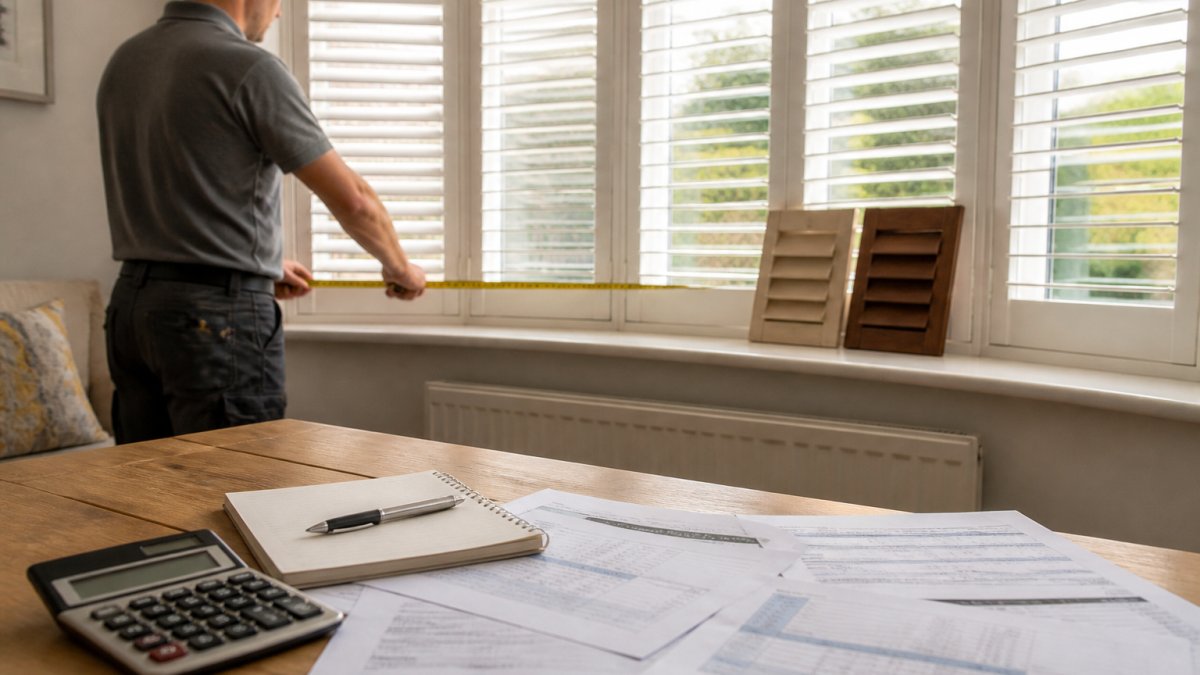
This is where ready-made options fall down. Standard blinds hung in a bay leave gaps at the angles, and the corners never quite meet. Bespoke shutters are templated to the actual geometry of your window, so each panel follows the angle of the bay and closes flush. The clean finish is the whole point.
We survey on site, take the measurements that matter and explain the panel options before anything is ordered. You get a firm quote, not a guess, and no obligation to proceed.
Do Custom Shutters Add Value to Your Property?
This is the question where most guides overreach, so let us separate what is measurable from what is merely perceived. Custom shutters can support resale value, though we would never promise a specific return, and the evidence for a direct valuation uplift is thin. What they do reliably is improve how a property shows. Buyers walking into a room with fitted shutters see a finished, considered space rather than a window waiting for a decision.
Estate agents tend to favour window treatments that look built-in and low-maintenance, and shutters photograph well. In period properties and homes with awkward or non-standard windows, they can be a genuine selling point because they solve a problem the next owner would otherwise inherit, angled bays, deep recesses and sash windows that off-the-peg blinds never quite fit.
But buyer preferences are not uniform, and that is the nuance the standard answer skips. A bespoke shutter installation is a fixed architectural element, and not every buyer wants one. Some will see dark timber panels in a bright modern room as a drawback; some will prefer the flexibility of curtains or the lower cost of blinds; some will simply not value a feature they did not choose. In a slow market, a highly personalised fit can narrow the pool of buyers as easily as widen it. The uplift, where it exists, tends to show up as faster sale or stronger offers in period and character homes rather than as a line on a valuation.
The realistic framing: shutters are unlikely to add more than they cost, and anyone claiming otherwise is overselling. Treat any resale benefit as a possible bonus, not a financial case. Where they earn their keep is in a home you plan to keep, lived in and enjoyed for years before any sale. Value for money here is measured in daily use, not a valuation uplift.
If you are selling within a year or two, or if your interior style is highly specific, weigh the resale argument carefully. Bespoke shutters are priced for the long stay; the next owner may not share your taste.
Book a Free Home Consultation Before You Decide
The only way to know whether shutters are worth it for your home is to have someone measure your actual windows and talk you through the options. That is exactly what we offer.
At Wooden Shutters, we are a family-owned Derbyshire business with 500+ happy homes behind us and a five-star rating to match. Our free home consultation brings expert advice to your door: we measure, explain the styles and materials, and give you a clear quote. No pressure, no obligation, and no sales script. If shutters are not right for your windows, we will tell you.
Our team combines traditional skills with modern technology, sources timber sustainably, and handles expert fitting and professional installation from start to finish.
Get started with Wooden Shutters and book a free home visit to see exactly what bespoke shutters would look like on your windows.
Frequently Asked Questions
Do custom shutters add value to a property?
Custom shutters can support resale value because buyers see them as a fitted, permanent window covering rather than a temporary one. Estate agents often treat made-to-measure shutters as a positive feature in listings, particularly in period or character properties. The uplift varies by area and property type, so treat it as one factor among several rather than a guaranteed return. Bespoke fit and a clean finish tend to matter more to buyers than the brand.
Are custom shutters better than ready-made shutters?
Ready-made shutters cost less upfront but rarely fit non-standard windows well, which leads to light gaps and awkward edges. Custom shutters are measured to your exact window size and shape, including bay windows and angled reveals, so they close properly and look built in. If your windows are standard and your budget is tight, ready-made can work. For awkward shapes or a long-term installation, made-to-measure is usually the better buy.
Do wooden shutters help insulate a room?
Wooden shutters for insulation work best as an extra layer at the window. Closed shutters reduce draughts and slow heat loss through the glass, especially when paired with good seals and double glazing. They will not replace proper insulation or glazing upgrades, but many homeowners notice a warmer room and less noise. The gain depends on window condition, shutter fit and how often you keep them closed.
How long do custom window shutters last?
Well-made custom shutters in a suitable timber typically last many years, often decades with basic care. Lifespan depends on wood quality, humidity in the room and how the shutters are finished. Cleaning with a dry cloth and avoiding prolonged damp keeps hinges and panels in good order. Compared with blinds that may need replacing every few years, a long-lasting fitted window covering spreads its cost over a much longer period.
