
Last Updated: November 20, 2026
Quick Summary
Yes, shutters can be fitted to conservatory roof windows, but the mounting differs from wall-mounted shutters because roof glazing sits at an angle. The main choice is between a fixed installation, a frame-mounted shutter, or a no-drill system that clamps or hangs from the existing structure, and a site check confirms which suits your roof.
- Check the roof pitch and whether the glazing is flat, sloping or mixed before choosing a method.
- Measure width and drop at three points each, and use the smallest figure as your working size.
- No-drill systems suit lighter shutters and rented homes; fixed fitting suits heavier, permanent installations.
- Measure from the inside face of the frame so the shutter is sized to fit the opening.
- Never stand on the roof glazing or glazing bars; use a stable platform and keep a second person present.
Table of Contents
- Benefits of Shutters for Light, Privacy and Heat Control
- Shutters for Sloping Windows: Feasibility and Mounting
- How to Measure Conservatory Roof Windows for Made-to-Measure Shutters
- Fitting Options: No-Drill Conservatory Blinds Versus Fixed Installation
- Shutters, Conservatory Roof Blinds and Materials Compared
- Condensation, Ventilation and Roof Glazing Safety
- Booking Your Free Home Visit to Measure Your Conservatory Roof
- Frequently Asked Questions
Shutters for conservatory roof windows are possible, but they are not a straightforward swap for the wall-mounted styles most homeowners know. Roof glazing sits at an angle, which changes how a shutter hangs, how it is supported and how it is operated. At Wooden Shutters, we measure and fit made-to-measure wooden shutters, and sloping conservatory roofs are one of the most common questions we hear before a visit.
The short answer is yes, with the right specification. The main decision is whether the shutter will be fixed in place, mounted on a frame, or operated by a no-drill system that clamps or hangs from the existing structure. Each approach suits different roof types, budgets and levels of permanence.
Shutters for conservatory roof windows suit homeowners who want privacy, glare control and a more finished look than standard roof blinds usually provide. They are less suitable where the roof has very shallow pitch, where access is restricted, or where the glazing bars cannot take additional weight. A site check is the only reliable way to confirm feasibility.
Here is what to check before you commit:
- The roof pitch and whether the glazing is flat, sloping or mixed
- The frame material, whether uPVC or aluminium
- How the shutter will be operated, by hand or by cord
- Whether the roof vents or opens, since this affects clearance
Our free home consultation covers exactly these points, with no obligation to buy.
Benefits of Shutters for Light, Privacy and Heat Control
Shutters can give a conservatory adjustable light and privacy, and offer a degree of heat control. The slats can be tilted to let in soft daylight while blocking direct glare, and closed fully when you want the room to feel private, especially where neighbouring windows overlook the space.
Heat is also a consideration. A conservatory roof takes the full force of summer sun, and the effect of a closed shutter on heat depends on the glazing, the slat design and how well the shutter seals.
Privacy matters most in the evenings, when a lit conservatory becomes a visible box to anyone outside. Closing the shutters solves this without losing the feeling of being in a bright, open room during the day.
Shutters for Sloping Windows: Feasibility and Mounting
Sloping windows need a different approach to vertical ones. Because the shutter must hang against an incline, the mounting system has to carry the weight without sagging or pulling away from the frame. Most sloping installations rely on a strong top fixing and a secure bottom track or tension system.
The feasibility of any mounting depends on the frame profile and the strength of the glazing bars. Where the frame is thin or the glass is heavy, a fixed installation may be better than a suspended one. A site assessment helps determine the most suitable method.
How to Measure Conservatory Roof Windows for Made-to-Measure Shutters
Measuring a sloping roof window is where most DIY shutter projects go wrong, because a frame that looks square from the floor is rarely square when you get up close. The method below is the one our fitters use on site, and it works for both fixed and no-drill systems.
Step 1: Establish safe access. You need to reach the full width and height of the window without overreaching. A stable platform step or a ladder with a top platform is safer than a standard stepladder, and a second person should steady the base.
Step 2: Measure the width at three points. Take the width at the top, middle and bottom of the window opening, measuring between the inside faces of the frame rather than the outer edges. Use the smallest of the three figures as your working width. On sloping frames the bottom measurement is often the widest, and using it will leave the shutter too tight at the top.
Step 3: Measure the drop at three points. Take the length from the top inside face to the bottom inside face at the left, centre and right. Again, use the smallest figure. On a pitched roof window the drop is measured along the slope, not vertically, so keep the tape flat against the glass line.
Step 4: Record the frame depth and profile. Measure how far the frame projects from the glass and note whether the profile is chamfered, ovolo or square. No-drill systems need a flat, consistent face to clamp onto, and a deep or rounded profile can rule them out.
Step 5: Map every obstruction. Mark the position of opening vents, hinges, handles, glazing bars, roof beams and any ceiling fittings that fall within the window reveal.
Step 6: Check the pitch. Use a digital angle finder or a spirit level with an angle scale against the glass. Record the pitch in degrees. Pitch affects which bracket and fixing method will work, so record it accurately and confirm feasibility with us before ordering.
Step 7: Photograph everything. Take wide shots of the whole roof and close-ups of each frame corner, the vent mechanism and the frame profile. Send these with your measurements so the supplier can check feasibility before cutting anything.
Watch out: measure from the inside face of the frame rather than the outside edges, so the shutter is sized to fit the opening.
If you are not confident on a ladder, or the roof has mixed pitches or unusual shapes, a professional measure and fit is the safer route. Our free home visit can help with measuring and confirm the fixing method before any order is placed.
Fitting Options: No-Drill Conservatory Blinds Versus Fixed Installation
No-drill conservatory blinds appeal to renters and to anyone who wants a reversible solution. They use tension or clamp fixings that avoid making holes in the frame, which keeps the original glazing intact. The trade-off is that they can carry less weight and may need adjusting over time.
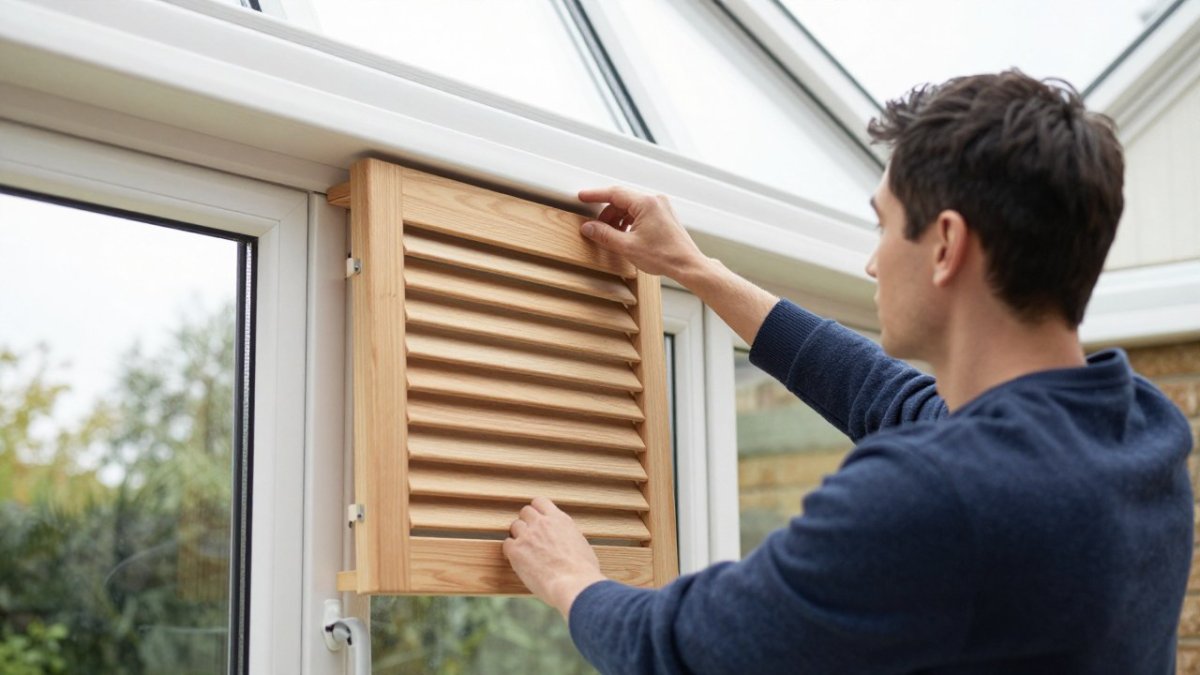
Fixed installation, where the shutter is screwed or bracketed to the frame, gives a more solid result and suits heavier, larger shutters. It is harder to reverse, so it makes sense when you are sure of the design and the property is yours to alter.
A useful rule: choose no-drill for lighter shutters and temporary or rented homes, and fixed fitting for permanent installations on larger or heavier windows.
Shutters, Conservatory Roof Blinds and Materials Compared
Roof blinds are cheaper and quicker to fit, but they usually offer less privacy and less insulation than a well-fitted shutter. Shutters are a more substantial investment than roof blinds. Wood, faux wood and aluminium each behave differently, so compare them directly:
| Material | Strengths | Limitations | Best for |
|---|---|---|---|
| Solid wood | Natural look, good insulation, repairable | Needs periodic care, heavier | Traditional and period homes |
| Faux wood | Moisture resistant, low maintenance | Less natural finish | Humid or high-use rooms |
| Aluminium | Light, durable, slim profile | Can feel cooler, fewer finishes | Large or lightweight roof frames |
Our made-to-measure wooden shutters use sustainably sourced timber. We are happy to advise on whether wood or an alternative suits your roof and room.
Pricing depends on the number and size of windows, the material, the fixing method and any custom shaping. Visit our website or book a free home visit for a quote tailored to your conservatory.
Condensation, Ventilation and Roof Glazing Safety
Covering roof glazing changes the moisture balance in a conservatory, and understanding why matters more than any single product choice. Warm, moist air rises and meets the coldest surface in the room, which on a conservatory is almost always the roof glass. When that surface falls below the dew point, water condenses on it.
The practical consequences are worth knowing before you buy. Water that collects on the frame or the back of a shutter can drip onto furniture, stain timber and encourage mould in the reveal. On older conservatories with single glazing or poorly sealed units, the effect is more pronounced than on modern units with a low-emissivity coating and argon fill.
Managing moisture with shutters fitted. Keep a background level of ventilation rather than sealing the room completely. Trickle vents on the conservatory windows, an open roof vent on dry days, and a gap at the top of the shutter run all help moist air escape.
Clearance and airflow. Leave a small gap between the back of the shutter and the glass, typically 10 to 20 mm depending on the system, so air can move and the shutter does not sit in a pool of condensation. Do not pack insulation into that gap.
Seasonal performance, realistically. In summer, a closed shutter reduces direct solar gain and glare, and the effect is strongest on south and west-facing roofs during the middle of the day. In winter, a shutter adds a layer of still air and can take the edge off heat loss, but it does not replace roof insulation, upgraded glazing or a proper thermal barrier.
Roof glazing safety and access. Working at height on a sloping roof is the main risk in any shutter project. Never stand on the glazing or the glazing bars, even on a polycarbonate roof, because point loads can crack or shatter panels. Use a stable platform, keep the ladder foot clear of the conservatory base, and have a second person present.
Booking Your Free Home Visit to Measure Your Conservatory Roof
The fastest route to the right shutters is a site visit. We come to your home, measure your conservatory roof, check the frame and roof pitch, and talk through options that suit your budget and your property. There is no pressure to buy on the day.
Book a free home visit with Wooden Shutters, and we will bring our experience with sloping windows and made-to-measure fitting to your conservatory. We are a family owned, Derbyshire local business.
Frequently Asked Questions
Can you put shutters on conservatory roof windows?
Yes, shutters can be made for many conservatory roof windows, but feasibility depends on the roof pitch, the glazing type and how the frame is built. Sloping glazing needs a shutter cut to the angle of the pane, and the fixing method must suit the frame. A surveyor or fitter can check your roof before any order is placed. Wooden Shutters offers a free home consultation where the window is measured in person, so you can confirm what will fit before committing to a purchase.
Can shutters be fitted to a conservatory roof without drilling?
Some no-drill options exist, usually using tension or clamp-style fittings that hold the shutter inside the reveal or against the frame. These suit rented homes or frames that should not be marked. Fixed installations generally give a more secure and stable result on sloping glazing, especially for heavier timber. Whether a no-drill fit is suitable depends on your window frame and the shutter weight, so ask for advice during your consultation.
How do you measure conservatory roof windows for shutters?
Measure the width at the top, middle and bottom of the opening, and the height along the slope of the glass rather than straight down. Record any angles, arches or mullions, and note the depth of the reveal. Take measurements to the nearest millimetre and repeat each one to check accuracy. Because sloping and unusual shapes are easy to misjudge, a made-to-measure survey during a home visit is the safest way to get a correct fit.
Are shutters or conservatory roof blinds better for controlling heat and glare?
Shutters give more adjustable control over light and privacy, and their slats can be angled to reduce glare while still letting in daylight. Conservatory roof blinds are often cheaper and simpler to operate but can be harder to fit neatly to angled glass. Heat control depends on the colour, material and how well the product is ventilated, so both options can help when chosen for the room. Pricing depends on size, materials and fitting, so request a quote from Wooden Shutters for current costs.
