
Last Updated: November 13, 2026
Quick Summary
Compare plantation shutter styles for bay windows by starting with the bay shape, then weighing full-height, café-style and tier-on-tier panels against angled and shaped options. Each style solves a different problem, and most bays suit two of them well. Check panel count, frame material, hinge type and finish so quotes compare like-for-like.
- Angled bays need panels meeting at an internal corner, so hinges and frame depth matter as much as louvre width.
- Full-height shutters give seamless coverage but are heavier and need solid fixing points and stronger hinges.
- Café-style shutters cover only the lower half, blocking the pavement eyeline while daylight pours in above.
- Tier-on-tier splits the window into two independent sections, but a three-sided bay needs at least six panels.
- Measuring only the widest point is the most common mistake and leads to panels that bind at the corners.
Table of Contents
- Why Bay Windows Need a Different Approach to Shutter Styles
- Start With the Bay Shape: Angled Bay Window Shutters and Beyond
- Full-Height Shutters: Clean Lines and Full-Window Coverage
- Café-Style Shutters: Lower-Level Privacy With Natural Light Above
- Tier-on-Tier Shutters: Independent Control Top and Bottom
- How to Measure a Bay Window for Shutters Before You Compare Quotes
- Matching Plantation Shutter Styles to Rooms, Privacy and Budget
- Book a Free Home Visit to Compare Shutter Styles in Person
- Frequently Asked Questions
Why Bay Windows Need a Different Approach to Shutter Styles
Bay windows throw a spanner in the works of almost every window treatment. Their angles, depth and mixed light mean a style that looks superb on a flat sash window can look clumsy or leave gaps on a bay. That is why comparing plantation shutter styles for bay windows deserves its own method rather than a glance at a brochure.
Plantation shutters are made-to-measure window coverings built from hinged panels set with adjustable louvres. The shape of the bay often decides more about the right style than the colour of the room does. Below, we set out five ways to compare styles, so you can judge each option on geometry, light, privacy and long-term value before anyone quotes you.
The five styles we cover each solve a different problem, and most bays suit two of them well.
Start With the Bay Shape: Angled Bay Window Shutters and Beyond
Angled bay window shutters are the starting point for any comparison, because the shape of the bay sets the rules. A three-sided angled bay needs panels that meet at an internal corner, which means the hinges and frame depth matter as much as the louvre width. A square bay, with its 90-degree returns, is more forgiving. Curved and circular bays demand shaped shutters built to a template, and those are always a bespoke job.
Walk into your bay and look at three things: the angle where the sides meet the front, the depth of the reveal, and whether the window handles protrude. Panels need clearance to swing open, and a deep reveal may swallow a standard frame. What most guides miss is that the corner post between two panels is where the fit is won or lost. Get that detail right and the shutters sit flush.
Full-Height Shutters: Clean Lines and Full-Window Coverage
Full-height shutters run from the top of the window to the floor in a single, uninterrupted panel, giving full-window coverage.
The trade-off is rigidity. On a bay, full-height panels are heavier, so the frame needs solid fixing points and the hinges need to be up to the weight. You also lose the ability to open the lower half independently. If your bay sits in a living room where you want the whole window dressed as one, this is our usual recommendation. If the bay is in a room where the dog watches the street from the sill, think twice.
Best for: living rooms and studies where a seamless finish matters most.
Skip if: you want to open the bottom half while keeping the top closed.
Café-Style Shutters: Lower-Level Privacy With Natural Light Above
Café-style shutters cover only the lower half of the window, leaving the top clear. They are the classic choice for street-facing bays, because they block the eyeline from the pavement while daylight keeps pouring in above.
On an angled bay, café-style panels follow the same corner angles as full-height ones. The difference is visual weight: half-height panels look lighter and suit smaller bays that would feel crowded by floor-to-ceiling shutters. The drawback is that the top half of the window stays bare, which is fine for privacy from passers-by but offers no light control on a bright south-facing front.
Tier-on-Tier Shutters: Independent Control Top and Bottom
Tier-on-tier shutters split the window into two independent sections, each with its own frame and louvres. You can close the bottom tier for privacy and leave the top tier open for ventilation and natural light, all without touching the other half.
For bay windows, this flexibility is the real selling point, but it also introduces constraints that other styles do not have. A tiered layout lets you follow the bay’s angles with separate panels at each level, which keeps the louvre lines aligned across the corner. In practice, this means a bay that faces the street can be private at eye level and bright at ceiling level at the same time.
The trade-off is in the frame and hinge count. Each tier needs its own frame, and each panel needs its own hinges, so a three-sided bay in tier-on-tier will have at least six panels and twice the hinge sets of a full-height equivalent. That adds weight to the frame and cost to the quote. It also means the corner post between panels has to carry two frames rather than one, which is where fitting skill shows. If the corner post is not set true, the louvre lines will not align between tiers and the bay will look off from across the room.
Hinge clearance is the other practical difference. Tier-on-tier panels are shorter than full-height panels, so they swing through a smaller arc and are less likely to foul window handles or deep reveals. That makes tier-on-tier a safer choice on bays where handles protrude or the reveal is shallow. Full-height panels, by contrast, need more clearance at the bottom and are heavier, so the frame needs solid fixing points.
Compared with café-style, tier-on-tier gives you light control on the top half as well as privacy on the bottom, which café-style cannot do. Compared with full-height, it gives you independent control but at the cost of more framework and a less seamless look.
If you are unsure which style suits your bay, ask for advice before you decide, because the alignment across the corner is a detail worth checking.
Curved or circular bays can be more demanding to fit, so ask for advice on the most suitable layout for your bay.
How to Measure a Bay Window for Shutters Before You Compare Quotes
Measuring a bay yourself will not replace a professional survey, but it will help you compare quotes fairly. Work through these steps with a metal tape and a notepad:
- Measure the width of each face of the bay at the top, middle and bottom of the reveal, and note the smallest figure.
- Measure the drop from the top of the reveal to the sill or floor at each face.
- Measure the depth of the reveal from the window frame to the wall face.
- Note the angle where each side meets the front, using a digital angle finder if you have one.
- Check window handle projection and whether any handles sit within the shutter’s swing path.
- Photograph each corner and the whole bay from two metres back.
Watch out: measuring only the widest point is the most common mistake, and it leads to panels that bind at the corners. A fitter will always work to the tightest measurement. If you want to see how the same thinking applies to another glazed room, our guide on conservatory shutters for overlooked gardens covers the privacy side in more depth.
Matching Plantation Shutter Styles to Rooms, Privacy and Budget
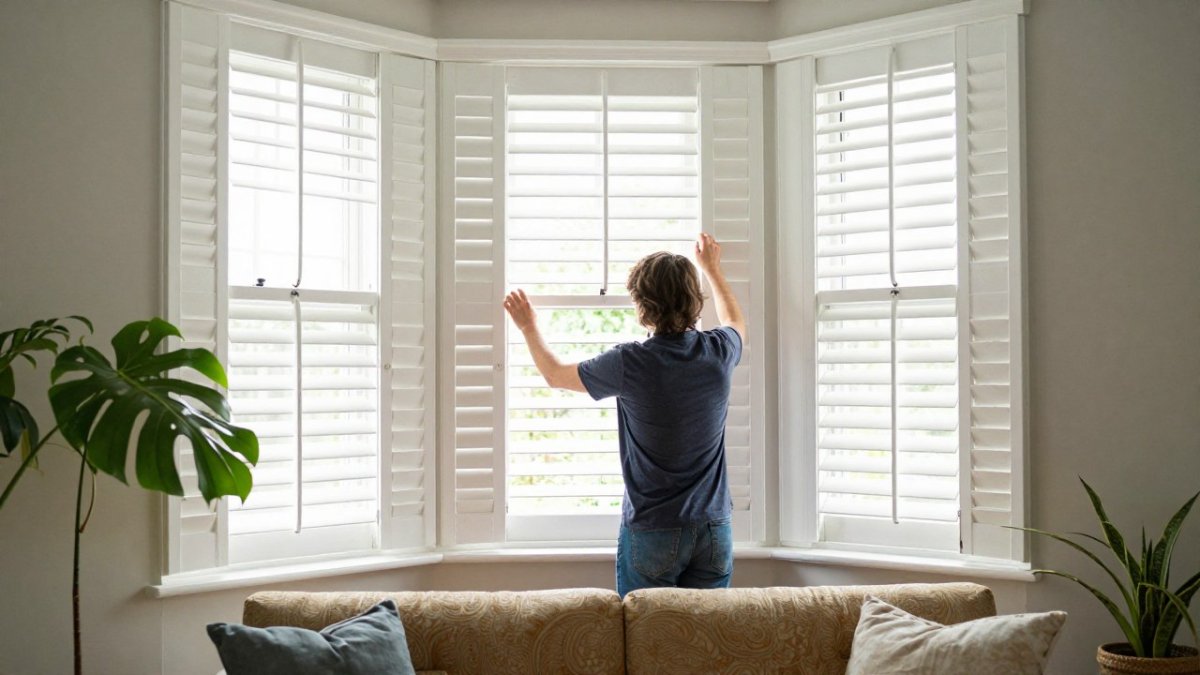
Style selection comes down to three questions: who uses the room, what the window faces, and what you want to spend. A front-facing bay in a family living room usually points to tier-on-tier, because it handles privacy and light in one fitting. A rear bay overlooking a garden can take full-height shutters without any privacy worry at all. Bedrooms often suit café-style if the bay is small, and curved or circular bays almost always need shaped panels regardless of style.
On cost, most guides stop at “prices vary”. That is not useful when you are trying to compare quotes. The factors that move a bay window shutter quote are consistent, and understanding them lets you compare like-for-like rather than headline figures.
Pricing depends on factors such as panel count, bay geometry, frame material, hinge type and finish. For a quote specific to your window, visit our website or book a free home visit.
Material choice can also affect the quote, so ask about the timber options available for your project. A common pattern is for the material to account for a larger share of the total than the style itself on smaller bays, so it is worth asking each supplier to break out material, frame and fitting separately.
When comparing quotes, check the hinge specification, as it can differ between suppliers.
When you compare quotes, ask each supplier to list panel count, frame material, hinge type, finish and whether the survey and fitting are included. A quote that omits the survey or fitting is not comparable to one that includes them. Ask also whether the price covers removal and disposal of existing blinds or curtains, and whether any making-good to the reveal is included.
| Style | Best for | Light control | Privacy | Relative cost | Main cost driver |
|---|---|---|---|---|---|
| Full-height | Living rooms, seamless look | Full window | High | Mid | Panel weight and heavy-duty hinges |
| Café-style | Street-facing bays, small bays | Top half only | Lower level | Low | Fewer panels and standard hinges |
| Tier-on-tier | Bedrooms, front rooms | Independent tiers | Adjustable | High | Double framework and hinge sets |
| Angled bay panels | Three-sided bays | Full window | High | Mid to high | Corner posts and bespoke angles |
| Shaped panels | Curved and circular bays | Full window | High | Highest | Template and bespoke joinery |
When comparing quotes, consider the whole specification and ask each supplier how they handle fitting and measuring.
Book a Free Home Visit to Compare Shutter Styles in Person
Comparing styles on a screen only takes you so far. Comparing styles in person can help you judge the angle of your bay and how panels will swing. That is why we offer a free home visit, with no obligation to order.
Wooden Shutters is a family-owned Derbyshire business, and we are committed to sustainable and ethical sourcing and traditional craftsmanship. Our shutters are bespoke, and we are rated 5★ with 500+ happy homes. If you have an awkward bay, we would be glad to discuss your project.
An awkward bay does not have to mean gaps, draughts or another set of blinds that never sat right. Get started with Wooden Shutters and book a free home visit, where we will measure your bay, show you samples and recommend the style that suits your room, your privacy needs and your budget.
Frequently Asked Questions
What style of plantation shutter styles is best for a bay window?
There is no single best option because the right choice depends on the bay shape and how you use the room. Plantation shutter styles include full-height, café-style, tier-on-tier and shaped panels, and the right choice depends on the bay shape and how you use the room. Book a free home visit for advice on your bay.
Are full-height or café-style shutters better for bay windows?
Full-height shutters cover the whole window, while café-style shutters cover only the lower half and leave the top open for natural light. Think about who can see in after dark before deciding between these two styles.
Can plantation shutters be fitted to angled bay windows?
Yes, angled bay window shutters can be made to suit angled bays. Accurate measuring is important, and a home visit can help record the angles and depth of your window reveal.
Do plantation shutters make a bay window look smaller?
The size and style of shutter panels can affect how open a bay feels, so ask to see samples in your own room before you commit.
