
Last Updated: October 29, 2026
Quick Summary
The best timber shutters for large windows use reinforced frames, well-spaced hinges and stable timber species, with wide openings split into two to three panels rather than one giant leaf. Panel width, not window width, is the number to control, since longer louvre spans flex and bow over time.
- Full-height panels across a wide opening need a reinforced frame and well-spaced hinges to stay true.
- As a guide, 89mm louvres suit panels up to about 600mm wide on most large-window configurations.
- A common pattern is a central opening pair flanked by fixed panels to limit weight per leaf.
- Reveal fit is generally the least expensive fitting method because the frame sits protected in the recess.
- A 2.4m by 1.5m window in mid-range hardwood with three panels costs roughly £1,100 to £1,950 installed.
Table of Contents
- Why Large Windows Need Different Timber Shutters
- 1. Full-Height Shutters for Large Windows: Full-Window Coverage
- 2. Tier-on-Tier Shutters for Large Windows: Light Control in Layers
- 3. Hardwood Shutters for Large Windows: Which Timber Holds a Wide Span
- 4. Timber Shutters for Bay Windows: Angles, Returns and Gaps
- Panel Widths, Louvre Sizes and Structural Limits
- Measuring Large Windows for Made-to-Measure Shutters
- What Drives the Cost of Timber Shutters for Large Windows
- Frequently Asked Questions
Why Large Windows Need Different Timber Shutters
A wide window span changes how a shutter performs. The best timber shutters for large windows need a frame that resists bowing, hinges that carry real weight, and a timber species chosen for stability.
Timber expands and contracts with moisture and heat. On a narrow window that movement is negligible; across a two-metre opening it compounds.
Below, we break down seven timber shutter approaches for large windows, compare the woods, and explain what drives cost. Most guides treat louvre size as a style choice; on a wide span, it is a structural decision.
1. Full-Height Shutters for Large Windows: Full-Window Coverage
Full-height shutters cover the entire window from floor to head, with louvres running the full drop.
Full-height shutters suit windows that are tall as well as wide, and where an uninterrupted contemporary look is wanted. You can view the full-height plantation shutters and enquire about them.
Watch out: ordering full-height panels wider than the frame can safely carry is the fastest route to a sagging louvre bank. Split wide openings into two or three panels rather than one giant leaf.
2. Tier-on-Tier Shutters for Large Windows: Light Control in Layers
Tier-on-tier shutters split the window into independent upper and lower sections, each with its own louvres.
The trade-off is more moving parts and more frame joints to get right. On a wide span, each tier needs its own support, which adds cost and complexity.
Best for: rooms where you want daylight up top and screening below.
Skip if: you want one simple, uninterrupted panel line.
3. Hardwood Shutters for Large Windows: Which Timber Holds a Wide Span
Dense, stable timber generally resists warping better than softwood, which is why hardwood is often considered for large windows. But “hardwood” covers a lot of ground, and the species you choose decides whether a wide panel stays flat.
Paulownia, Cedar and Hardwood Compared
Paulownia is lightweight, which helps on wide panels because the shutter weighs less and puts less strain on hinges. It is also a fast-growing, renewable timber. The downside: it dents more easily than denser woods.
Cedar offers natural moisture and insect resistance, making it sensible for rooms with damp or temperature swings. It is stable, though softer than some hardwoods.
Denser hardwoods hold a wide span with the least movement, but they are heavier and usually cost more.
4. Timber Shutters for Bay Windows: Angles, Returns and Gaps
Timber shutters for bay windows require careful measuring. A bay has angled faces, return sections, and corners that a standard rectangular panel cannot fill.
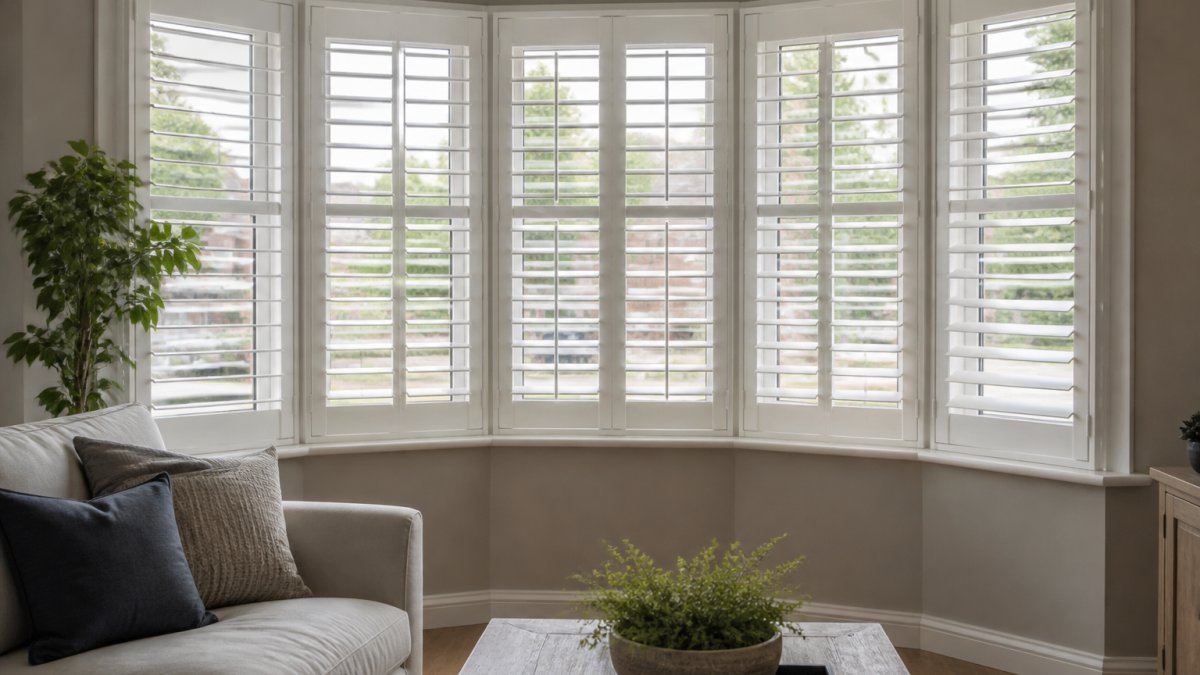
Bay windows are generally measured face by face, with panels cut to follow the angles and returns. Our bespoke bay window shutters service handles angles and returns.
Watch out: a bay with deep returns needs panels that clear the wall as they swing. Measure the swing, not just the opening.
Panel Widths, Louvre Sizes and Structural Limits
Panel width and louvre span are not styling choices; they decide whether a shutter stays flat for twenty years or sags within two. The guidance below is general, and every opening should be checked before manufacture.
Why louvre span matters more than panel width
A louvre is a thin timber blade supported at each end. The longer the blade, the more it flexes under its own weight and moves with humidity. An 89mm louvre in a 450mm-wide panel is stiff; the same louvre in a 900mm-wide panel will bow noticeably over time.
As a general engineering consideration, louvre deflection and hinge loads increase with panel width, so wider panels generally need reinforced frames and heavier hinge specifications.
Louvre size and span limits
| Louvre size | Typical comfortable panel width | Best use on large windows |
|---|---|---|
| 47mm | Up to ~450mm | Fine control, traditional look, smaller panels |
| 63mm | Up to ~500mm | Balanced light control and rigidity |
| 89mm | Up to ~600mm | Most large-window configurations |
| 114mm | Up to ~700mm with extra support | Contemporary look, maximum light per blade |
These are indicative limits, not guarantees. A 114mm louvre across a 700mm panel needs more hinge points and a stiffer frame than an 89mm louvre across a 500mm panel. For the wide-blade look on a very wide opening, the answer is usually more panels, not wider ones.
When a wide opening needs split panels
A single leaf across a two-metre opening is almost always the wrong specification. Splitting the opening into three or four panels does four things:
- Shortens each louvre span, reducing flex.
- Distributes weight across more hinges and more frame fixings.
- Allows individual panels to be opened independently for cleaning and access.
- Reduces the load on any single hinge point, which is where failures usually start.
A common pattern on wide openings is a central pair of panels that open like French doors, flanked by fixed panels. This keeps the sightline clean while limiting the weight carried by any one leaf.
Hinges, frames and fixing points
Hinge count generally rises with panel height and weight. The frame itself must be reinforced or rebated into the reveal so the fixings carry load into masonry rather than plasterboard. On very wide spans, a mid-rail or T-post between panel groups adds rigidity and gives the frame a fixing point at the centre of the opening.
Do not accept a quote that specifies panel widths without stating hinge counts and frame fixing method. On large windows, those two details are where cheap specifications fail.
When to call in a specialist
Very wide, very tall, arched, or deep-return openings are generally treated as specialist installations. The same applies if the wall is timber-framed, the reveal is shallow, or the window has handles that intrude into the shutter swing. Panel layout, frame design and fixing method all need to be worked out on site rather than chosen from a brochure.
A quick specification checklist
Before ordering, confirm in writing:
- Individual panel widths and the number of panels.
- Louvre size and the maximum unsupported louvre span.
- Hinge count per panel and hinge type.
- Frame section, reinforcement and fixing method.
- Whether a mid-rail or T-post is included on wide spans.
- Swing clearance for any opening panels, including handles and deep returns.
Measuring Large Windows for Made-to-Measure Shutters
Made-to-measure shutters live or die on measurement. Measure the width at the top, middle and bottom of the opening, and the height at both sides and the centre. Using the smallest figure is generally advisable, because walls are rarely square.
For a large window, also record where you want the panels to divide, since that split decides hinge placement and swing clearance. You can start the process on our bespoke shutters page.
What Drives the Cost of Timber Shutters for Large Windows
Large-window timber shutters are generally priced according to factors such as the size of the panel area, timber species, panel count, shape complexity and fitting method. Final pricing depends on window size and material choice, and current prices or a quote are available from our website.
The four cost drivers, in order of impact
1. Total panel area. This is the biggest single driver. A wide opening generally requires more material, which affects cost.
2. Timber species. The choice of timber can affect cost, and on a wide span it can also influence the frame and hardware specification.
3. Panel count and hardware. More panels generally means more frame, hardware and labour, which can affect cost.
**4.
Fitting method and its effect on the total
Fitting is usually quoted separately and depends on the fixing method:
- Reveal fit (frame set into the window recess) is the most common and generally the least expensive, because the frame is protected by the reveal.
- Face fit (frame mounted on the wall face) is used where the reveal is too shallow, and typically costs more because the frame is deeper and the fixings must be finished neatly.
- Bay and angled installations carry the highest fitting cost because of templating, scribing and the number of separate frame sections.
Fitting costs vary with the window and access, so please request a quote for your specific opening.
A worked example
Take a flat living-room window 2.4m wide by 1.5m high, 3.6 square metres of opening.
- Mid-range hardwood, three panels, 89mm louvres: product around £900-£1,600.
- Fitting, reveal method: around £200-£350.
- Indicative installed total: roughly £1,100-£1,950.
The same opening in a dense hardwood with 114mm louvres and a reinforced frame could reach £1,800-£2,800 installed. A bay of similar total area with three angled faces could add several hundred pounds on top of either figure.
Treat these ranges as a benchmark, not a quote. A specification that comes in far below the range usually means thinner panels, fewer hinges or a lighter timber than the opening needs.
What changes the final quote
Beyond these factors, the following can also affect the price:
- Access and installation height, upper-floor windows and scaffolding add cost.
- Window furniture, handles, vents and trickle vents may require cut-outs or extended frames.
- Finishes, painted finishes and colour matching are usually included, but specialist stains or two-tone finishes can add a premium.
- Survey and templating, bespoke bays and arches require a site template, which shows up in the quote.
How to compare quotes fairly
Ask every supplier for the same six items: panel widths, louvre size, hinge count, frame specification, fitting method and whether survey/templating is included. A quote that is cheaper because it specifies wider panels, fewer hinges or a lighter timber is not a like-for-like comparison, it is a different, weaker product.
Frequently Asked Questions
Are timber shutters suitable for large windows?
Yes, provided the panels are built for the span. Wide openings are split into several panels rather than one oversized leaf, and the frame is fixed into the wall or reveal with enough fixing points to carry the weight. A consultation can help confirm what your specific window needs.
Which shutter style is best for large windows?
Full-height shutters for large windows give the cleanest full-window coverage and suit tall doors and floor-to-ceiling glazing. Tier-on-tier shutters for large windows are better where you want the top section open for daylight while the bottom stays private, which is common on street-facing rooms. The right choice depends on how you use the room and what is overlooked.
Do large timber shutters need a divider rail?
A divider rail helps on tall panels. It splits the louvres into two independently adjustable sections, so you can open the top for light and close the bottom for privacy. On very tall windows it also adds rigidity across the panel face. On wide but short windows it is usually unnecessary. Ask during your free home visit whether your window height justifies one.
Are timber shutters suitable for bay windows?
Timber shutters for bay windows are one of the most common requests, because bays rarely match standard sizes. Each face of the bay is measured separately, and the panels are shaped to follow the angles, including the return sections at each side. Awkward angles are a measuring problem, not a reason to settle for blinds.
How much do timber shutters for large windows cost?
Pricing depends on the number of panels, the timber chosen, louvre size and how complex the window shape is. Large windows use more material and more panels, so they cost more than a standard casement. Pricing depends on window size and material choice. For current prices or a quote, please visit our website.
Large windows expose every weakness in a shutter, from the timber to the hinge to the measurement. If you want panels that stay flat across a wide span and fit your angles without gaps, get a proper on-site measure first. Wooden Shutters offers free home consultations, sustainably sourced timber, and expert fitting across the region, backed by our 5-star rating and 500+ happy homes. Get started with Wooden Shutters and book a free home visit to size your large windows correctly.
