
Last Updated: November 11, 2026
Quick Summary
Conservatory shutters for overlooked gardens are slatted panels fitted to the glass, with louvres tilted to block sightlines while still letting in diffused daylight. Ground-level overlooking is usually handled by tilting the slats roughly 30 to 45 degrees downward, while elevated viewpoints need a steeper tilt.
- Tilt slats about 30 to 45 degrees downward to break ground-level sightlines while keeping daylight.
- Elevated overlooking windows may need tilts of 60 degrees or more, or a fixed privacy panel.
- Test the privacy angle from outside at the overlooking point, then mark the tilt setting.
- Open louvres during the warmest part of the day to avoid overheating a south-facing conservatory.
- Measure each opening at top, middle and bottom in millimetres, and check figures twice before ordering.
Table of Contents
- How Slat Angle Controls Privacy Without Blocking Light
- Measuring Conservatory Windows and Roof Lights for Shutters
- Fitting Shutters to Conservatory Roof Windows
- Conservatory Shutters vs Blinds for Garden-Facing Rooms
- Thermal Performance, Light Control and Upkeep
- Booking a Free Home Visit to Plan Your Conservatory Shutters
- Frequently Asked Questions
Conservatories are wonderful rooms to sit in, but they are also very exposed. Glass walls and a glass roof let in light from every direction, and that same openness can make you feel watched from the garden next door or the path behind the fence. This guide from Wooden Shutters explains how conservatory shutters for overlooked gardens can solve that problem without sealing the room off from the daylight you chose it for.
Most standard blinds were designed for flat windows. A conservatory has sloped panes, awkward corners and often several different planes of glass in one room. Off-the-shelf products rarely meet all of those edges properly, and gaps let people see straight in. Shutters designed for the space work differently.
Thinking about the room in zones can help. The low glazing facing the garden may need a different solution from the roof above a seating area.
- Garden-facing walls usually need the most coverage
- Roof lights need shutters that fit the pitch of the glass
- Corners often need a bespoke solution, not a standard panel
How Slat Angle Controls Privacy Without Blocking Light
Slat angle is the single most useful control you have, but most guides stop at ’tilt them to suit’. The specific angle matters far more than the general advice suggests, and it depends on where the overlooking comes from.
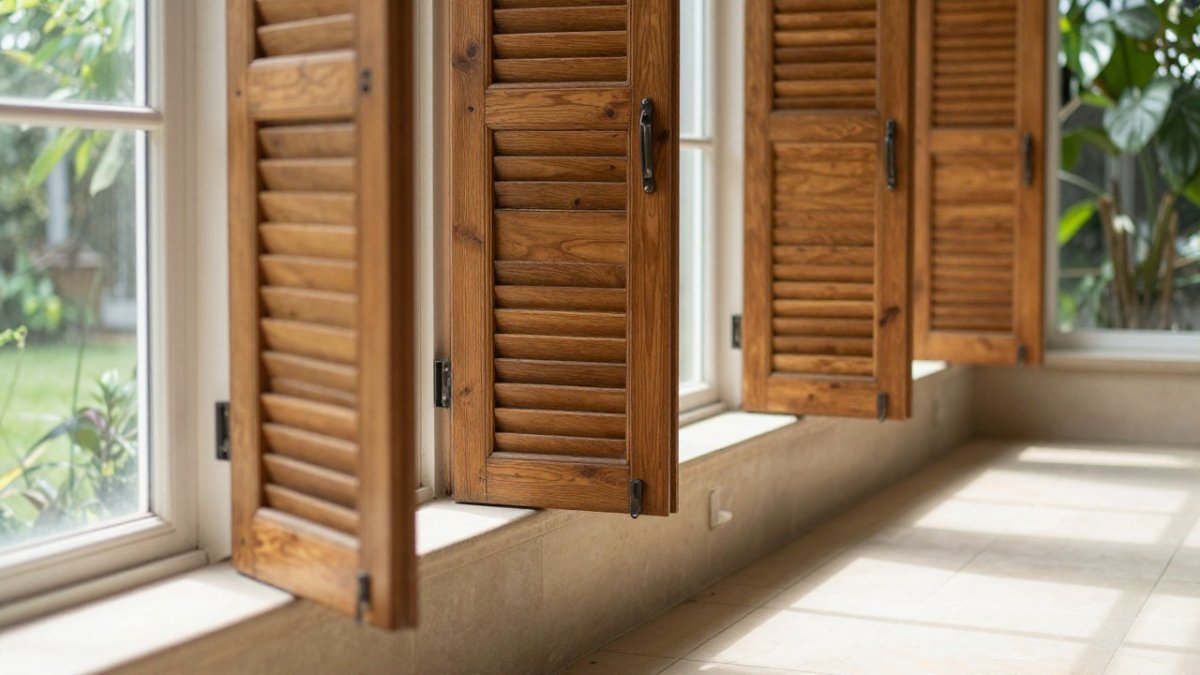
For ground-level overlooking, a neighbour at a kitchen window, a passer-by on a pavement, a garden gate, a slat tilt of roughly 30 to 45 degrees downward from horizontal is usually enough to break the line of sight. At that angle the louvres overlap visually from a standing eye height outside, while the gap between slats still admits a useful amount of diffused daylight. Tilting them fully closed is rarely necessary and is the most common reason a conservatory feels gloomy after shutters are fitted.
The calculation changes when the overlooking window is elevated. A first-floor bedroom window, a dormer, or a property on higher ground looks down into the conservatory at a steeper angle, and a shallow tilt that works against a ground-level neighbour will not block that sightline. In practice, the higher the overlooking window relative to your conservatory floor, the more the slats need to tilt toward closed, often 60 degrees or more, to interrupt the downward view. If the overlooking window is directly above and close, no slat angle will fully solve it, and the answer is a combination of tilt and, where the conservatory roof allows, a fixed privacy panel or a denser slat spacing on the affected elevation.
A practical way to set the angle is to test it from the outside rather than the inside. Ask someone to stand at the overlooking point, the neighbour’s window, the path, the gate, at the time of day the sun is behind them, and adjust the slats until your eye contact is broken. Mark the tilt on the tilt rod or motor setting so you can return to it. One ‘privacy position’ per elevation is often enough, with a more open daytime position for light.
Watch out: a fully closed shutter on a south-facing conservatory can cause the room to overheat in summer, so open the louvres during the warmest part of the day and rely on the 30-to-45-degree privacy tilt rather than full closure.
Café-style shutters, where the top half of the panel is independent of the bottom, are worth considering for overlooked gardens. You can keep the lower half tilted for privacy at seated height while leaving the upper section more open for light, which suits a conservatory used mostly in the evening.
Measuring Conservatory Windows and Roof Lights for Shutters
Accurate measurements decide whether shutters fit or leave unsightly gaps. Measure each pane or section separately, noting the width at the top, middle and bottom, because conservatory frames are rarely perfectly square. Record the depth of the reveal and any obstructions such as handles, hinges or radiators.
For roof lights, measure the sloped length and the width at several points. Write every figure down and label it with its location in the room. Mixing up measurements is one of the most common causes of rework.
- Take each measurement in millimetres
- Measure at the top, middle and bottom of every opening
- Note any radiator, handle or hinge that could affect fitting
- Check your figures twice before ordering
Fitting Shutters to Conservatory Roof Windows
Roof windows present their own challenge. The glass is angled, the weight must be supported safely, and the shutter needs a secure mounting point. Fitting usually involves either a frame-mounted system or a tension-based fit, depending on the structure of your roof.
Installation methods vary. Some shutters are fixed with drilled brackets, while no-drill options use tension rods or specialist fixings. Drilling into a glazed roof frame needs care, so ask your installer which method suits your frame before any work begins.
Conservatory Shutters vs Blinds for Garden-Facing Rooms
Both options control light and privacy, but they perform differently over time. Blinds are cheaper to buy in the short term and easy to replace. Shutters generally cost more upfront and can be sturdier than blinds, and they may help reduce heat gain.
| Option | Best for | Privacy | Durability |
|---|---|---|---|
| Conservatory shutters | Long-term privacy and style | Strong, adjustable slats | Very durable |
| Roller blinds | Budget-friendly, simple fitting | Good when fully closed | Moderate |
| Pleated blinds | Soft look and light diffusion | Moderate | Moderate |
Pros of shutters: adjustable slats, sturdy, good insulation, classic appearance.
Cons of shutters: higher upfront cost, need accurate measuring, heavier to move.
Pros of blinds: lower price, quick to fit, wide colour choice.
Cons of blinds: can sag or fade, gaps are common on angled glass.
Thermal Performance, Light Control and Upkeep
Shutters affect temperature in two distinct ways, and understanding the difference helps you decide where to spend money.
In summer, the benefit is solar control. A conservatory with a glass roof can reach uncomfortable temperatures because solar gain through the roof is far higher than through the walls. Closing the louvres on roof shutters during the middle of the day intercepts direct sun before it reaches the glass, reducing the heat that enters the room. Slat angle matters here too: a partly open slat still admits light but blocks the direct beam, which is why a mid-tilt position often feels cooler than full closure with the room in shade.
In winter, the benefit is a reduction in heat loss. A shutter panel creates a still air layer between the slats and the glazing, which slows conductive and convective losses. The improvement is real but modest compared with upgrading the glazing itself, and it depends on how well the shutter fits the reveal, gaps at the edges undo much of the benefit. The difference is usually felt most in a conservatory that is otherwise single-glazed, and least in one already fitted with modern low-emissivity glass. Shutters improve comfort and can reduce peak heat gain, but they are not a substitute for insulation or glazing upgrades.
Light control is the third function. Tilting louvres lets you cut glare on a bright afternoon without losing the view out, which matters in a room used for reading or screens. The trade-off is that a conservatory with shutters on every elevation can feel enclosed if all panels are set the same way; zoning the tilt, more open on the shaded side, more closed on the sun side, keeps the room balanced.
Upkeep is straightforward but worth doing properly. Keep the louvres clean with a soft brush or cloth, and keep the room ventilated to limit moisture build-up, which can affect any wooden product over time. In a conservatory, the bigger maintenance risk is condensation on the glazing behind the shutters, especially in winter; leaving a small gap at the edge of the panel and ventilating the room daily reduces it.
Booking a Free Home Visit to Plan Your Conservatory Shutters
Planning shutters for an overlooked garden is easier with someone who can see the room in person. At Wooden Shutters we offer a free, no-obligation home visit where we measure, talk through slat angles and show you the options that suit your conservatory. Our family-owned team, based locally in Derbyshire, sources timber sustainably and offers professional fitting.
Pricing depends on your window sizes, shutter style and fitting requirements, so please contact us or visit our website for a personal quote. Book a Free Home Visit and let us help you plan a conservatory that is private, bright and comfortable all year round.
BUTTON: Book a Free Home Visit
CARD_TITLE: Is your conservatory overlooked?
CARD_TEXT: Wooden Shutters measures and fits bespoke shutters for conservatories and roof lights.
Frequently Asked Questions
Are conservatory shutters good for privacy?
Yes. Shutters with adjustable slats can help block the line of sight from neighbouring properties and overlooking gardens while still allowing natural light to enter. Closing the slats fully gives near-complete seclusion, and angling them partly closed lets daylight through while hiding the room from people outside. The level of privacy depends on slat size, fit and how tightly the frame sits against the glazing, so a made-to-measure fit usually performs better than a loose standard size.
Can conservatory shutters stop neighbours seeing into a garden-facing room?
They can, provided the shutters are closed to an angle that blocks the sightline from the neighbour’s position. Overlooked gardens often sit at a higher level or a closer distance than expected, so it helps to check the angle from both inside and outside before ordering. Shutters fitted across the full glazed area, including side panels where the room meets the garden, remove the gaps that would otherwise show through.
How do you measure conservatory windows for shutters?
Measure the width and height of each opening at three points, top, middle and bottom, and record the smallest figure for width and height. Note any angles, bay sections or sloping roof panels separately. For conservatory roof windows, measure the pitch and the exact glazing dimensions, as these affect whether a standard size will fit. Because irregular conservatory openings rarely match standard sizes, a made-to-measure order is usually the safer option. Confirm the final figures during a home visit before manufacturing starts.
Are conservatory shutters suitable for sloping or unusually shaped windows?
Yes, when they are made to measure. Sloping roof windows, angled panels and irregular bay shapes need bespoke frames cut to the exact opening, which avoids the gaps that off-the-shelf blinds often leave. Each section should be assessed for fixing points and the weight it will carry, particularly on overhead glazing. A site assessment is the best way to confirm whether a particular shape can be fitted neatly.
