
Quick Summary
Custom shutter installation means measuring, making and fitting shutters to the exact dimensions of your windows rather than trimming an off-the-shelf size. It usually begins with an in-home survey before anything is ordered, which matters most for period properties and bay windows in Derbyshire.
- Made-to-measure shutters are typically preceded by an in-home survey before ordering.
- Measure each opening at three points: top, middle and bottom.
- Bay window panels are measured separately because angles and widths differ.
- Ask for the survey observations and manufacture window in writing.
- Wooden Shutters offers free home consultation visits with no obligation.
Table of Contents
- What Custom Shutter Installation Involves in Derbyshire
- Interior Shutters Versus Roller Shutters: Which Suits Your Home
- Shutter Consultation: What Happens at the Home Visit
- Bay Window Shutters and Non-Standard Window Shapes
- The Shutter Installation Process From Measuring to Fitting
- How Long Shutter Installation Time Takes
- Booking Your Free Home Visit in Derbyshire
- Frequently Asked Questions
What Custom Shutter Installation Involves in Derbyshire
Last Updated: November 1, 2026
Custom shutter installation is the process of measuring, making and fitting shutters to the exact dimensions of your windows, rather than buying an off-the-shelf size and trimming it to fit. For homeowners in Derbyshire with period properties, bay windows or unusual openings, that difference decides whether the shutters look finished or leave gaps around the frame. Made-to-measure shutters are typically preceded by an in-home survey before anything is ordered.
Browse the full shutter range to see the styles available before you book a visit.
Pricing depends on the number of windows, their shape and the finish chosen. Request a quote from Wooden Shutters for current pricing on your specific windows.
Interior Shutters Versus Roller Shutters: Which Suits Your Home
Interior shutters and roller shutters are different products serving different needs, and the search results often blur the two. Interior shutters are fixed or hinged panels mounted inside the window reveal, giving privacy and light control without covering the glass.
Privacy and light control. Interior shutters with adjustable louvres let you tune light and privacy room by room: wide louvres let more daylight through when open, while narrower louvres give more privacy when closed. Full-height plantation shutters suit larger windows and give a consistent look across a façade.
Durability and maintenance.
Security.
Room suitability. Interior shutters work well in living rooms, bedrooms, and studies where the look matters and the window frame is solid. They are also the better choice for bay windows and non-standard shapes because each panel can be made to the individual angle.
Cost and disruption.
If your priority is privacy, light control, and a finished look inside the home, interior shutters are usually the right product. If your priority is security for a ground-floor or commercial opening, roller shutters are the stronger option. If you are unsure, the consultation is the time to ask about mounting options, cleaning, and how each would look against your existing décor.
Many homeowners find that interior shutters work well in living rooms and bedrooms, where they can be closed for privacy and opened to let in daylight. A common mistake is choosing louvre size without considering how much light you want when the shutters are open. Wider louvres let more light through, while narrower ones give more privacy when closed. Full-height plantation shutters are one option for larger windows, and you can see the full height plantation shutters range to compare them with your existing windows.
The two products suit different priorities, as summarised below.
| Product | Best for | Key difference |
|---|---|---|
| Interior shutters | Privacy, light control, finished look | Mounted inside the window reveal |
| Roller shutters | Security for ground-floor or commercial openings | Stronger option for security |
| Interior shutters with adjustable louvres | Room-by-room light and privacy | Wide louvres admit more light; narrow give privacy |
| Full-height plantation shutters | Larger windows, consistent façade look | Give a uniform look across the façade |
Shutter Consultation: What Happens at the Home Visit
A shutter consultation is a visit where a specialist looks at your windows in person, takes measurements and discusses options before any order is placed. Wooden Shutters offers free home consultation visits, so advice is given in your own home. The aim is to understand how you use each room, what you want the shutters to achieve and what your windows are actually like.
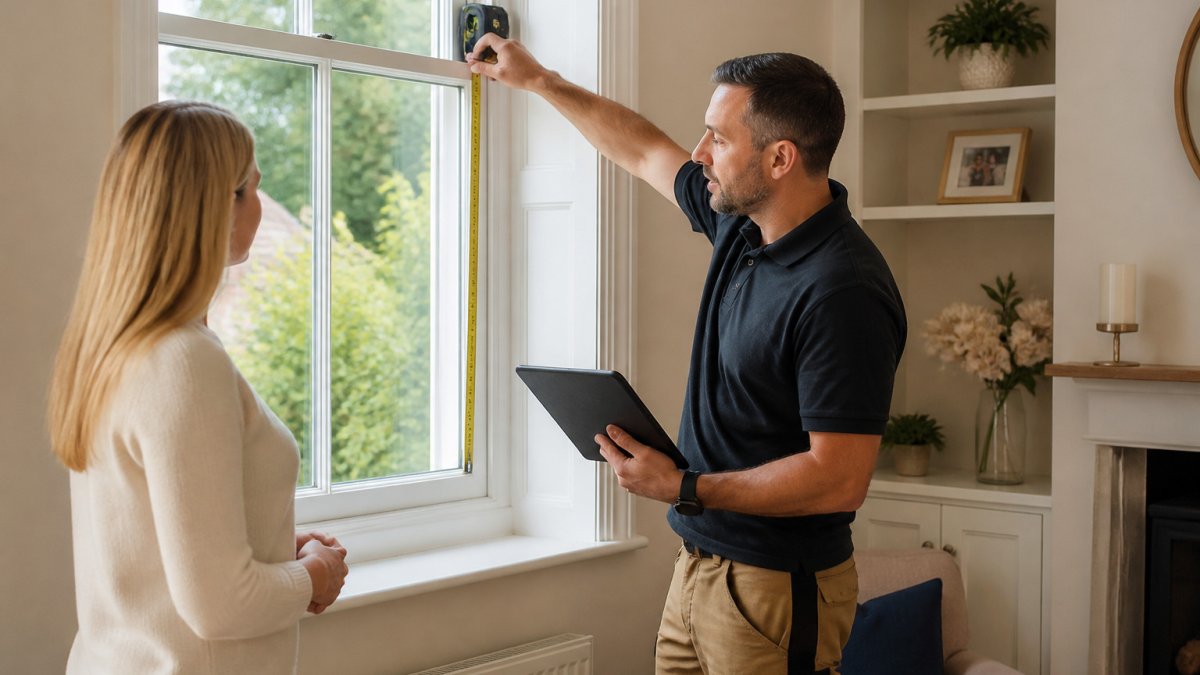
Take the chance to ask questions, including about the installation and any aftercare.
Wooden Shutters operates a no-obligation, no-pressure service. Our advice is to prepare a short list of the rooms and windows you want to cover, along with any concerns about light or privacy, so the visit covers everything in one go.
Bay Window Shutters and Non-Standard Window Shapes
Bay windows and other non-standard shapes are where ready-made shutters most often fail. Angled panels, splayed reveals and uneven sills mean that standard sizes leave visible gaps.
The main challenge is accurate measurement. Each bay panel may be a different width and angle, and small errors compound across the window. The survey should record every panel separately, check the sill height and confirm how the shutters will fold or stack when opened. If you have a bay with a fixed centre pane and angled side panels, ask how each section will operate independently.
For a bespoke bay window shutters option tailored to your window shape, arrange a free home visit.
The Shutter Installation Process From Measuring to Fitting
1. Survey and measurement. The installer measures every opening at three points, top, middle and bottom, and records the reveal depth, sill level, and any obstructions such as radiators, sockets, or curtain tracks. For bay windows, each panel is measured separately because angles and widths differ. The surveyor should also note the condition of the window frame and wall construction, since rotten timber or crumbling plaster needs resolving before manufacture rather than on fitting day. Ask for these observations in writing so any remedial work can be agreed and priced in advance.
3. Manufacture. Bespoke shutters are made to the confirmed measurements, which typically takes several weeks depending on order size, finish, and material. Timber shutters with a painted finish often take longer than composite or MDF alternatives because of drying and finishing time. Ask for an estimated manufacture window in writing and confirm whether delivery to site is included or whether you need to be present to receive the panels.
4. Delivery check. When the shutters arrive, the installer should check each panel against the survey sheet before fixing, panel widths, hinge positions, and finish, and flag any discrepancy before drilling. A common pattern is for minor adjustments to be made on site, such as easing a hinge or trimming a packer, but significant errors should be raised before installation begins.
5. Fitting. Fixings must suit the wall or frame: masonry plugs for solid walls, timber screws for studwork, and specialist fixings for sash windows where the frame must not be compromised. The installer should test every panel through its full operation, opening, closing, tilting, and stacking, with you present before leaving. Care is needed to avoid damaging plaster, and any making-good around the frame should be agreed in advance.
6. Aftercare and adjustments. Good installers offer a workmanship guarantee and a mechanism warranty, and they will return to adjust hinges, tilt rods, or catches that settle after the first few weeks. Ask what the guarantee covers, how long it runs, and how to report an issue. Keep the survey sheet and specification, they are the reference point if a panel needs replacing or a hinge needs adjusting later.
If the window frame is rotten, the reveal is out of square, or the wall construction is unsuitable for the chosen fixing, fitting can fail or cause damage. Ask the installer to flag these issues during the survey rather than on installation day, so repairs can be agreed and priced before manufacture begins.
If you want to see the styles available before booking a visit, browse the shutter range.
How Long Shutter Installation Time Takes
Wooden Shutters does not publish fixed installation timescales, so request an estimate for your property when you arrange the visit.
Booking Your Free Home Visit in Derbyshire
If you are ready to take the next step, a free home visit is the simplest way to see your options for your own windows. Arrange your free home visit through the contact page, describe the rooms you want to cover and mention any bay windows or unusual shapes. You will receive advice in your home with no pressure to buy.
Before the visit, gather a rough list of window locations and the rooms where privacy or light control matters most.
Frequently Asked Questions
How long does shutter installation take?
Installation time depends on how many windows are being fitted, their shape and whether any preparation work is needed. Lead times between ordering and fitting vary with manufacturing schedules, so ask for a written timeline when you book.
What happens during a shutter consultation?
A consultation is usually a home visit in which the installer looks at each window, discusses light control, privacy and style preferences, and takes precise measurements. You are not obliged to buy anything at this stage.
Which shutters work best for bay windows?
Bay windows usually need shutters measured and made for each angled panel, because standard sizes rarely fit neatly.
Are custom shutters worth the investment?
Custom shutters are made for your specific windows. Compare the total cost, including fitting, before deciding. Pricing depends on the number of windows, the shutter style and the fitting requirements, so request a quote from Wooden Shutters for current figures.
