
Table of Contents
- Custom Shutters vs Ready Made Blinds: The Core Differences
- Ready Made Blinds Pros and Cons
- Custom Shutters Cost: What You Pay For and Why
- Shutters vs Blinds for Insulation and Energy Efficiency
- How to Measure Windows for Ready Made Blinds
- Window-by-Window Decision Guide: Bay, Roof and Awkward Shapes
- Maintenance, Repairability and Long-Term Value
- Which Should You Choose?
- Frequently Asked Questions
Last Updated: October 21, 2026
Custom Shutters vs Ready Made Blinds: The Core Differences
The choice between custom shutters versus ready made blinds comes down to fit, longevity and control. Custom shutters are made to your exact window measurements in a solid frame, while ready made blinds come in standard sizes you trim or adjust on site.
Most comparisons online pit custom blinds against ready made blinds, or shutters against blinds in general.
At Wooden Shutters, we fit bespoke timber shutters across Derbyshire and the surrounding counties, and we regularly meet homeowners weighing up a high street blind against a made-to-measure shutter. The honest answer is that both have a place.
Here is the short version:
- Ready made blinds are cheaper upfront, quick to buy and easy to swap. They suit rentals, short-term fixes and simple rectangular windows.
- Custom shutters are built to the millimetre, sit inside the recess or on the face of the wall, and hold their alignment for years. They cost more initially and reward you over time.
The differences that actually change the result
| Dimension | Ready made blind | Custom shutter |
|---|---|---|
| How it is sized | Standard nominal sizes, trimmed or adjusted on site | Measured to the millimetre, built to the opening |
| Fit at the edges | Light gaps are common because the fit is approximate | Frame closes against the reveal, limiting edge light |
| Light control | Slats or fabric tilt or roll, but edges leak | Louvre panels tilt and close, with tighter edge control |
| Privacy at night | Depends on fabric and gaps; silhouettes can show | Solid panels block sightlines when closed |
| Heat retention | Loose fit lets air move around the edges | Still-air barrier against the glass |
| Awkward shapes | Rarely fit bay, roof or arched windows cleanly | Built to angle, slope and shape |
| Repair and replacement | Usually replaced whole when a mechanism fails | Panels, louvres and hardware can often be replaced |
| Upfront cost | Lower | Higher |
| Expected lifespan | A few years | Many years with care |
What that means in practice
The fit difference is the one that drives the rest. A blind sold as a nominal size often measures slightly under, so even a careful DIY fit leaves a light gap that no amount of adjustment closes.
The trade-off is commitment. A ready made blind can be swapped when you redecorate; a shutter is a fitted fixture and should be chosen with a longer view.
Below, we break down the real differences, the costs, the insulation question and how to decide window by window.
The most common mistake with ready made blinds is buying by nominal size without checking the actual recess. A blind sold as “120cm” often measures slightly under, leaving a light gap that no amount of adjustment fixes.
Ready Made Blinds Pros and Cons
Ready made blinds win on speed and price. You can buy a fabric blind off the shelf, fit it in an afternoon and change it whenever the mood takes you. That flexibility is genuine, and it is why they remain popular.
The trade-offs show up later. Standard sizes rarely match a real window opening exactly, so you either trim the blind or accept light gaps down the sides. Fabric creases, slats bend, and cords and mechanisms wear out faster on cheaper stock.
Pros:
- Low upfront cost and no lead time
- Wide choice of colours, fabrics and finishes
- Easy to replace if damaged or if you redecorate
- Simple DIY fitting for standard rectangular windows
Cons:
- Light bleed around the edges because the fit is approximate
- Shorter lifespan, especially on budget fabric and thin slats
- Limited options for bay, roof and angled windows
- Little or no insulation benefit
Custom Shutters Cost: What You Pay For and Why
Custom shutters cost more than ready made blinds, and the gap is wider than most people expect. You are paying for measured accuracy, solid materials, joinery time and professional fitting rather than a boxed product off a shelf.
So what does your money actually buy? A made-to-measure shutter is built around your window, not cut down to fit it. That means a proper frame, panels that align flush, and hardware chosen for the weight of the timber. The result is a window covering that closes cleanly, blocks light at the edges and keeps its shape.
A worked example: one typical living-room window
To make the comparison concrete, take a standard rectangular window of roughly 120cm wide by 140cm high in a living room. The figures below are illustrative ranges based on common market patterns, not a quote, and they will move with material, finish and fit.
| Cost line | Ready made blind | Custom shutter |
|---|---|---|
| Purchase price | £30-£120 | £350-£900 per window |
| Measuring | DIY, no cost | Included in survey |
| Installation | DIY, no cost, or £40-£80 for a fitter | Usually included in the quoted price |
| Cleaning and maintenance over 10 years | £0-£30 (replacement slats, cords) | £0-£20 (damp cloth, occasional touch-up) |
| Replacement over 10 years | 2-3 replacements at £30-£120 each | None expected |
| Indicative 10-year total | £90-£440 | £350-£920 |
On that single window the ready made blind can look cheaper even after replacements. The picture changes when you factor in what the shutter does while it is there: tighter light control, better heat retention and no repeat purchase. It also changes on awkward windows, where a ready made blind may not fit at all and the only real alternative is bespoke.
Where the money actually goes
- Measuring and survey: a site visit catches taper, obstructions and recess depth that a tape measure at home misses.
- Materials: hardwood, engineered timber and quality finishes cost more than thin slats and budget fabric.
- Joinery and assembly: panels built to the millimetre take time, and that time is the product.
- Hardware: hinges, louvre rods and frames sized for the weight of the panel, not a universal bracket.
- Fitting: professional installation protects the frame and the warranty, and avoids the callbacks that DIY fit often creates.
Pricing depends on window count, window size, material, finish and the complexity of the shape, so we quote each home individually rather than publish a single figure. As a rule, budget for a meaningful premium over off-the-shelf blinds, then weigh that against how many years you will keep them. For a whole house, the premium on the main rooms is usually where the value sits; the spare room can wait.
| Factor | Ready Made Blinds | Custom Shutters |
|---|---|---|
| Upfront cost | Lower | Higher |
| Fit accuracy | Approximate, trimmed on site | Measured to the millimetre |
| Expected lifespan | A few years | Many years with care |
| Insulation benefit | Minimal | Noticeable heat retention |
| Awkward windows | Poor fit or unavailable | Built to shape |
| Replacement cycle | Every few years | Rarely, with repairable parts |
Ask for a quote that separates product, survey and fitting. A single bundled figure is harder to compare, and it hides where the cost actually sits.
Shutters vs Blinds for Insulation and Energy Efficiency
Shutters vs blinds for insulation is where the gap becomes obvious. A solid shutter panel with tight tolerances creates a barrier of still air against the glass, which helps hold warmth in the room.
That matters more as energy costs stay high. Many homeowners find that closing shutters at dusk keeps a room warmer for longer, particularly on older windows and single glazing.
Ready made blinds offer some light filtering and privacy, yet their loose fit lets air move around the edges. If heat retention is your main goal, shutters are the stronger choice. If you simply want to soften glare, a blind does the job.
Close shutters before the room cools in the evening, not after. Trapping the warmth already in the room works better than trying to recover it later.
How to Measure Windows for Ready Made Blinds
Measuring for ready made blinds is straightforward if you measure the right thing. Decide first whether you want a recess fit, with the blind inside the window opening, or a face fit, mounted on the wall or frame above it. Each needs different measurements.
For a recess fit, measure the width at the top, middle and bottom of the opening and use the smallest figure. Measure the drop in three places and use the shortest.
- Choose recess or face fit before measuring
- Measure width in three places, record the smallest
- Measure drop in three places, record the shortest
- Note any tiles, handles or obstructions
- Check the blind’s actual size against the nominal size
- Confirm fitting brackets clear the frame
A common mistake is measuring once at the top and assuming the window is square. Older homes rarely are, and a few millimetres of taper is enough to leave a visible gap.
Window-by-Window Decision Guide: Bay, Roof and Awkward Shapes
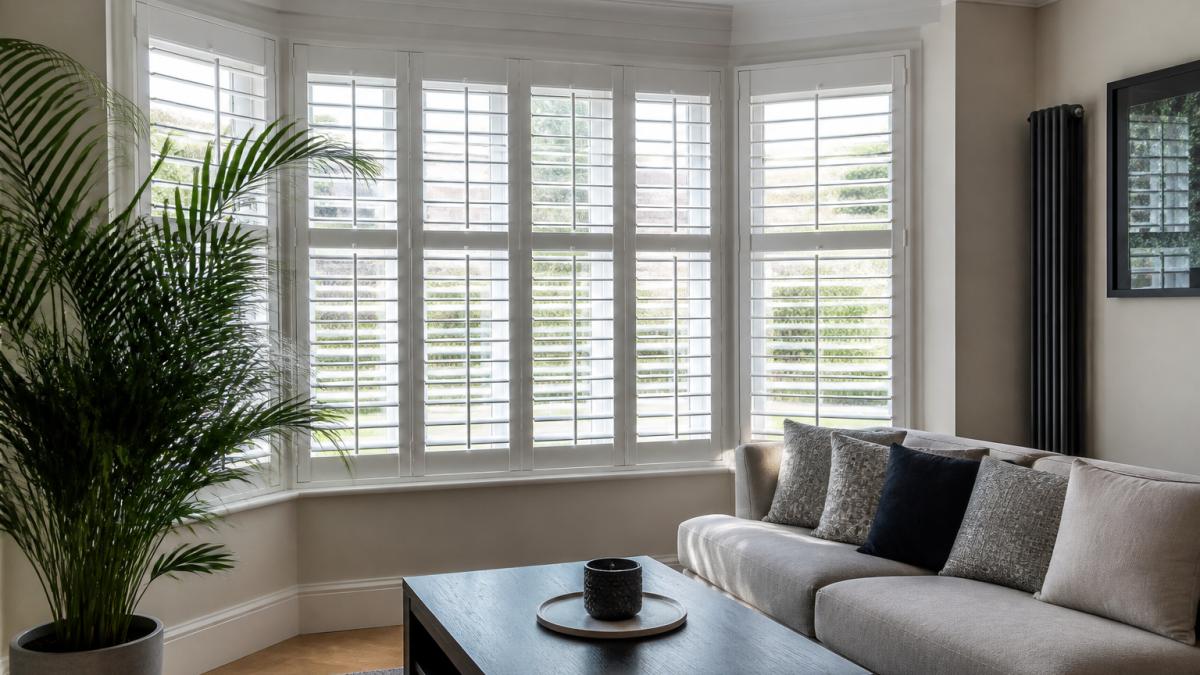
Bay, roof and angled windows are where ready made blinds struggle. Standard blinds assume a flat, square opening, so bay windows with splayed reveals and roof windows set into a slope rarely get a clean fit.
For a bay window, made-to-measure shutters follow each angle and sit neatly in the reveals, closing the gaps that plague off-the-shelf blinds.
- Standard rectangular window: ready made blinds are a reasonable budget choice.
- Bay window: custom shutters handle the angles and give a cleaner finish.
- Roof window: match the product to the frame and tilt; bespoke is safer.
- Arched or shaped window: custom build is usually the only accurate option.
Maintenance, Repairability and Long-Term Value
Maintenance is simpler than most people assume, provided the material is right. Quality timber shutters wipe clean with a damp cloth, and individual panels or louvres can often be repaired or replaced rather than the whole unit. Fabric blinds stain, crease and fade, and once a mechanism fails the blind is usually binned.
That repairability is central to long-term value. A shutter fitted properly can be adjusted, refinished or partly replaced, so it keeps looking right for years. A cheap blind is a disposable product, replaced every few years, and those replacement costs add up quietly.
The cheapest window covering is rarely the best value. Total cost of ownership favours the product you fit once and keep, not the one you replace every few summers.
Which Should You Choose?
There is no single winner. Choose ready made blinds for a simple rectangular window, a tight budget or a short-term fix. Choose custom shutters where fit, privacy, insulation and longevity matter, and especially where the window is bay, roof or an awkward shape.
If you are weighing up custom shutters versus ready made blinds across a whole house, the sensible approach is to mix them. Spend on the windows you use most and where fit is hardest. Save on the spare room.
That is where we come in. Book a free home visit and we will show you exactly what works for your windows.
Frequently Asked Questions
Are custom shutters worth the extra cost compared with ready-made blinds?
It depends on how long you plan to stay and how awkward your windows are. Ready-made blinds are cheaper upfront but often need replacing within a few years, and they rarely fit bay or non-standard windows cleanly. Custom shutters cost more initially, yet their lifespan, accurate fit and added insulation offer long-term value. For homeowners staying put for a decade or more, the benefits of bespoke often outweigh the initial investment.
Do shutters provide better insulation than blinds?
Generally yes. A well-fitted shutter creates a barrier of trapped air between the glazing and the room, which slows heat loss. Fabric blinds offer some insulation when closed but tend to sit closer to the glass and leave gaps at the edges. The difference is most noticeable on single-glazed or older windows. The effectiveness varies by window, wall construction and how you use the shutters.
Are ready-made blinds easy to fit yourself?
For a standard rectangular recess, yes. Most ready-made blinds come with brackets and basic instructions, and a confident DIYer can fit one in under an hour with a drill and a spirit level. The risk lies in measuring: a few millimetres out and you get light gaps or a blind that will not sit flush. Bay windows, roof windows and out-of-square openings are much harder and often end up looking uneven.
What are the downsides of shutters?
The main ones are upfront cost, lead time and reduced flexibility. Bespoke shutters are made to order, so you wait weeks rather than picking something up the same day. They are also fixed to the window, which limits how much you can change the look later without replacing them. On very small or rarely used windows, the cost per square metre can feel hard to justify compared with a simple roller blind.