
Last Updated: October 25, 2026
Quick Summary
Choosing the right window privacy solution starts with understanding your specific needs: whether you prioritize blocking views, controlling light, or both, and whether your main concern is daytime or nighttime privacy. The best solution matches your room’s requirements and balances privacy against trade-offs in natural light and outward visibility.
- Daytime and nighttime privacy require different solutions because natural light and interior light create opposite challenges
- Every privacy option involves trade-offs between privacy gained, natural light retained, and outward view preserved
- Wooden shutters last 15-20 years with minimal maintenance, while blinds typically last 5-10 years and require more frequent cleaning
- Layered treatments combining shutters, sheers, and blinds provide flexibility to adjust privacy throughout the day
- Bathrooms and bedrooms need complete privacy at all times, while living areas benefit from adjustable solutions
Table of Contents
- Understanding your window privacy needs
- Window privacy film options
- Window privacy without blocking light
- Plantation shutters for privacy
- Bay window privacy ideas
- Comparing blinds, curtains and alternative solutions
- Room-by-room privacy recommendations
- Durability, maintenance and removal
- Frequently Asked Questions
Understanding your window privacy needs
Choosing the right window privacy solution starts with understanding what you actually need. Privacy isn’t one-size-fits-all, it depends on your room, the time of day, and what matters most to you: blocking views, controlling light, or both.
We often find homeowners make this decision backwards. They pick a solution first, then discover it doesn’t solve their actual problem.
Daytime versus nighttime privacy
Daytime privacy and nighttime privacy are fundamentally different challenges. During the day, natural light is working against you, anyone outside can see through most barriers if the interior is darker than the exterior.
This distinction matters because it changes what solutions actually work. A sheer curtain provides decent daytime privacy but offers almost nothing at night. Wooden shutters, by contrast, handle both equally well, you close them for complete privacy whenever you need it.
Privacy, daylight and view trade-offs
Every privacy solution involves trade-offs. The more privacy you gain, the more you typically sacrifice in terms of natural light or outward visibility. The trick is finding where those trade-offs work for your space.
Frosted glass and textured films give you privacy while still allowing diffuse light through. You lose the view, but your room stays bright.
Window privacy film options
Window privacy film is one of the most straightforward privacy solutions available. It’s applied directly to your existing glass, requires no structural changes, and can be removed if needed.
The Glass and Glazing Federation guidance on window film installation outlines best practices for professional application. Properly installed film adheres smoothly without bubbles, creases, or clouding. Poor application creates visible defects that undermine both privacy and aesthetics.
Frosted, etched and textured glass films
Frosted, etched, and textured films create a diffused, opaque appearance while still allowing light through. These work well when you want privacy without darkening a room.
The visual effect varies by product. Frosted film gives a uniform, milky appearance. Etched film mimics the look of acid-etched glass with finer detail. Textured films can replicate sand-blasted glass or add subtle patterns.
Decorative and stained-glass effect films
Decorative and stained-glass effect films combine privacy with visual interest. Rather than a uniform frosted look, they add patterns, colours, or geometric designs. These work particularly well in hallways, kitchen windows, or anywhere you want privacy without sacrificing the aesthetic appeal of the window itself.
Stained-glass effect films can mimic traditional leaded glass or create modern geometric patterns. They provide privacy while making the window a design feature rather than a functional necessity.
Window privacy without blocking light
For many homeowners, the ideal solution maintains privacy while keeping rooms bright and open. Innovative Night Day Blinds are designed to balance both privacy and natural light throughout the day. This is where translucent materials and layered approaches become valuable.
Building Research Establishment guidance on daylighting and visual comfort emphasises that natural light significantly affects wellbeing and energy efficiency.
Translucent materials and sheer solutions
Translucent materials like frosted glass or specialised privacy fabrics allow light through while obscuring detail. Sheer curtains and lightweight linen fabrics work similarly, they soften the light, blur outside views, and maintain a sense of openness.
Sheer solutions work best in combination with other treatments. A sheer curtain alone provides minimal privacy at night when interior light is on, but paired with wooden shutters or blinds, it gives you flexibility.
Plantation shutters for privacy
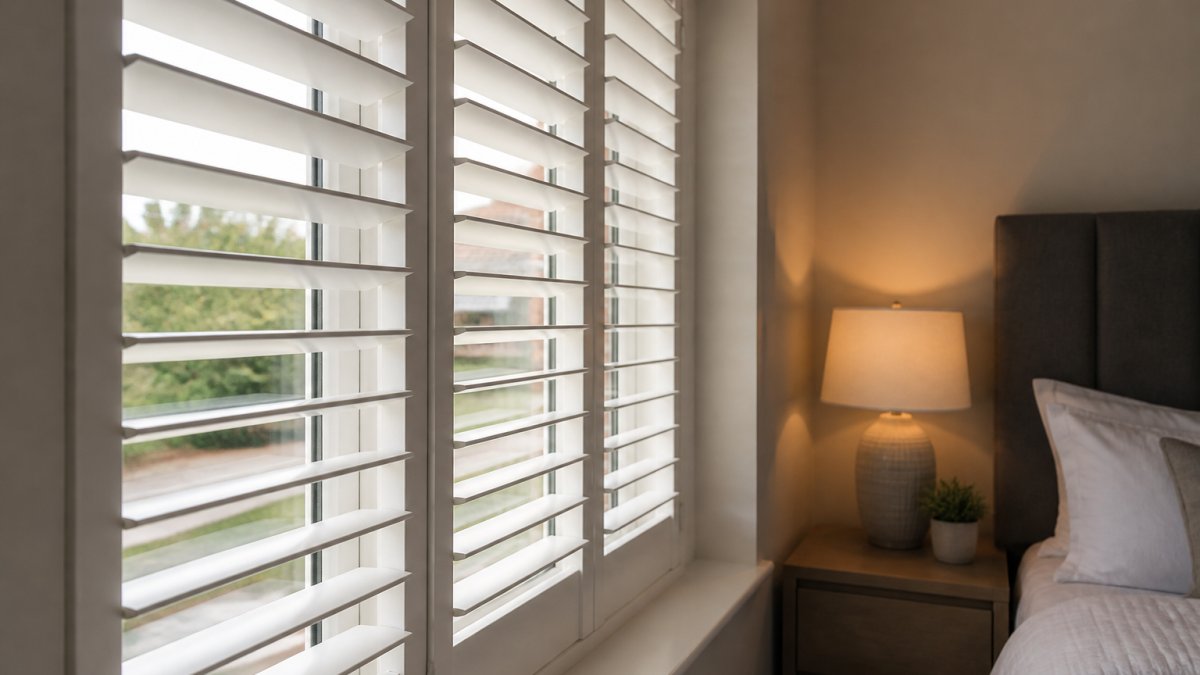
Wooden shutters are one of the most effective and controllable privacy solutions available. Unlike fixed treatments like film or frosted glass, shutters let you adjust your privacy level throughout the day, open them wide for full light and view, partially close them to filter light while maintaining some visibility, or shut them completely for total privacy.
The louvres can be adjusted to any angle, giving you precise control over what you see and who sees in. They work equally well for daytime and nighttime privacy, and they add genuine value to your home.
Opacity control and customisation
The beauty of plantation shutters lies in their adjustability. By tilting the louvres, you control exactly how much light enters and how much visibility you have outward.
Customisation is key. Full Height Plantation Shutters can be tailored to your exact window dimensions and design preferences for complete privacy control.
Bay window privacy ideas
Bay windows present a unique privacy challenge. Their angled planes mean standard treatments often leave gaps, and the complexity can make off-the-shelf solutions frustrating. Layered approaches and bespoke solutions work best.
Layered window treatments for angled spaces
Layering different treatments across a bay window’s angles gives you flexibility and ensures no gaps. A combination of shutters on the main window, sheer curtains across the whole bay, and blackout blinds on the side panels creates multiple privacy layers you can adjust independently.
Bespoke bay window shutters are another option. Rather than forcing standard shutters into angled spaces, custom-fitted shutters follow the bay’s geometry perfectly. Each panel operates independently, so you can adjust privacy on each plane separately.
Comparing blinds, curtains and alternative solutions
Different privacy solutions suit different priorities. Understanding the strengths and limitations of each helps you make an informed choice.
| Solution | Privacy Level | Light Control | View Retention | Durability |
|---|---|---|---|---|
| Wooden shutters | Excellent | Excellent | Excellent | 15-20 years |
| Vertical blinds | Good | Good | Good | 5-10 years |
| Roller blinds | Good | Good | Poor | 3-7 years |
| Curtains | Good | Good | Poor | 5-10 years |
| Window film | Excellent | Moderate | Poor | 5-10 years |
| Frosted glass | Good | Good | Poor | Permanent |
Vertical blinds and traditional blinds
Vertical blinds and traditional horizontal blinds offer adjustable privacy and light control at a lower cost than shutters. They’re effective for filtering light while maintaining some visibility outward. The main limitations are durability, they typically last 5-10 years before degradation, and gaps.
Traditional blinds work well in rental properties or temporary situations where you don’t want to commit to permanent installation. They’re easy to replace if damaged.
Curtains and sheer fabrics
Curtains and sheer fabrics offer privacy and light control with a soft, flexible aesthetic. Heavy curtains provide complete privacy and excellent light blocking.
Curtains work well as part of a layered approach. A sheer curtain paired with blackout blinds or shutters gives you options for every situation. The downside is maintenance, curtains need regular washing, and they can feel heavy and dated depending on style.
Room-by-room privacy recommendations
Privacy needs vary dramatically by room. A solution that’s perfect for a bedroom might be completely wrong for a kitchen or living area.
Bathrooms and bedrooms
Bathrooms and bedrooms require the highest privacy levels. You need complete privacy from outside views at all times, day and night. Frosted window film works well in bathrooms because it provides privacy while keeping the space bright.
Avoid sheer curtains or translucent solutions in these rooms. They look soft and elegant but fail to deliver the privacy you actually need.
Living areas and kitchens
Living areas and kitchens often benefit from privacy during specific times, early morning, late evening, or when you want to control who can see in, but you don’t need complete privacy all day. Layered solutions work well here.
Many homeowners prefer the flexibility of adjustable solutions in these spaces. Wooden shutters let you open them fully during the day to maintain the bright, open feel of a living area, then close them in the evening for privacy.
Durability, maintenance and removal
The longevity and maintenance requirements of your privacy solution affect its true cost and convenience over time.
Wooden shutters, when properly made and installed, require minimal maintenance. A gentle wipe with a soft cloth removes dust. Unlike blinds, which accumulate dust in hard-to-reach places, shutters are straightforward to clean.
Window film lasts 5-10 years depending on quality and sun exposure. Over time, it can bubble, peel, or develop a hazy appearance. Removal requires scraping and can leave adhesive residue. Curtains need regular washing and can fade in direct sunlight. Blinds require more frequent cleaning and mechanisms wear out, requiring replacement.
When you’re ready to choose a privacy solution, book a free home visit with our team.
Frequently Asked Questions
How can I stop people from looking in my windows without blocking all the light?
Window privacy without blocking light is achievable through several methods. Translucent films and frosted glass effects maintain visibility while obscuring details from outside. Sheer curtains or linen fabrics provide daytime privacy without darkening your room. Plantation shutters with adjustable slats let you control opacity throughout the day, closing them during evening hours and opening them to admit daylight during the day. The key is choosing a solution that matches your specific privacy needs at different times.
What is the best way to make a bay window more private?
Bay window privacy ideas require solutions that accommodate angled walls and multiple panes. Layered window treatments work well: combine plantation shutters on the central pane with sheer curtains or privacy film on side panels. Custom-fitted shutters are ideal for bay windows because they follow the angles precisely and allow individual pane control. This approach maintains the architectural character of your bay while delivering privacy and light control exactly where you need it.
Do window privacy films work at night, and what are the downsides?
Window privacy films provide excellent daytime privacy but offer limited nighttime protection if interior lights are on, as the contrast makes silhouettes visible from outside. Downsides include potential air bubbles or creases during installation, difficulty removing them without surface damage, and reduced clarity of your outward view. Some films can appear hazy indoors. For complete 24-hour privacy, combine privacy film with shutters or curtains that close at night, giving you flexibility and full control.
Are shutters or blinds better for window privacy?
Both offer privacy, but with different strengths. Shutters provide superior privacy control because solid panels block visibility completely when closed, and custom-fitted shutters eliminate gaps. They’re durable and require minimal maintenance. Blinds offer flexibility with adjustable slats and cost less initially, but gaps between slats allow some visibility when closed. Shutters work better for bedrooms and bathrooms where total privacy is essential, whilst blinds suit living areas where you want adjustable light and privacy. Your choice depends on your privacy requirements and aesthetic preference.
What is the best window privacy solution for a bathroom?
Bathrooms require maximum privacy, so solid-panel shutters or frosted glass films are ideal. Shutters deliver complete opacity when closed and can be customised to your window shape. Frosted privacy film obscures vision while allowing light through, creating a clean, modern look. Avoid thin blinds or translucent curtains in bathrooms, as they may allow silhouettes to show. Consider moisture resistance: wooden shutters with proper finishing hold up well in humid environments, whilst some films may bubble or peel. A combination approach, shutters with a decorative frosted film, offers both privacy and style.
How long do window privacy solutions typically last, and what maintenance do they need?
Lifespan varies by solution. Quality wooden shutters require minimal care, occasional dusting and light cleaning. Privacy films last 5-10 years depending on sun exposure; they may fade or peel over time. Blinds typically need replacement every 5-10 years. Curtains last 5-15 years but fade with sunlight. Maintenance demands are low for shutters and films, moderate for blinds (dust collection), and higher for curtains (regular washing). Sustainably sourced wooden shutters are a long-term investment for privacy and home value.
Can I use a temporary privacy solution if I’m renting or unsure about permanent installation?
Yes, several non-permanent options work well for renters. Adhesive-free privacy films stick via static and remove cleanly without damage. Temporary blinds and curtain rods require no drilling. Removable window stickers and decorative films are easy to apply and take off. These solutions deliver real privacy without landlord permission issues. However, they’re less durable and may need replacement more frequently. If you own your home and want long-term privacy, custom shutters or permanent films are better value and provide superior performance and aesthetics.
How do I choose between frosted glass, etched glass and sandblasted privacy films?
All three obscure visibility whilst allowing light through, but differ in appearance and durability. Frosted films have a smooth, uniform finish and are the most affordable option. Etched films mimic the look of traditional etched glass with a more textured appearance. Sandblasted effects provide a deeper, more realistic glass-like finish. Frosted is best for modern homes, etched suits traditional properties, and sandblasted works in either setting. Consider your window’s current aesthetic and the level of light diffusion you prefer. All three are easy to install and remove, making them ideal for testing privacy preferences.
The right window privacy solution depends on your room, your priorities, and how much control you want over privacy and light throughout the day. At Wooden Shutters, we specialise in bespoke wooden shutters designed to your exact windows and needs. Our custom-fitted shutters provide superior privacy control, last for decades, and add genuine value to your home. Contact us for a free consultation, and let’s find the solution that works for your home.
