
Table of Contents
- Why Bespoke Conservatory Shutters Solve the Overlooked Problem
- Planning Privacy by Window Position and Sightline
- Conservatory Shutters for Light Control and Year-Round Comfort
- Shutter Styles and Louvre Options for Conservatories
- Shutters for Shaped Conservatory Windows and Awkward Angles
- Your Conservatory Shutter Measuring Guide
- Made-to-Measure Conservatory Shutters: Costs, Lead Times and Alternatives
- Conclusion
- Frequently Asked Questions
Last Updated: October 21, 2026
Why Bespoke Conservatory Shutters Solve the Overlooked Problem
Bespoke conservatory shutters for privacy are custom-made panels fitted to your exact glass, so you control who sees in without blocking the light.
Most guides skip the real problem: a conservatory is mostly glass, often on three sides and overhead. Your neighbour’s landing looks straight down into it, the street sees through the side panels after dark, and off-the-shelf blinds only cover the rectangle they were cut for.
Where Standard Blinds Fall Short
Ready-made blinds are built to standard widths. Conservatory glass rarely is. You end up with light bleeding round the edges, a gap at the top of each pane, and cords hanging in a room you use every day.
Roller and vertical blinds also stack at the top of the frame, leaving the upper glass exposed, exactly what an overlooking window sees first.
Cutting ready-made blinds to fit an angled or shaped conservatory pane rarely works. You lose the tension in the fabric, the slat spacing goes uneven, and the blind sags within a season. Measure for a made-to-measure panel instead of trimming a cheap one.
Planning Privacy by Window Position and Sightline
Privacy planning starts with a walk around your garden, not a catalogue. Stand where your neighbour stands, note which panes are exposed, then treat each window differently.
- Facing the street or a footpath: full-height panels with tight-closing louvres.
- Facing a neighbour’s upstairs window: café-style panels on the lower half, louvres angled up.
- Facing open garden or fields: leave these clear and spend your budget elsewhere.
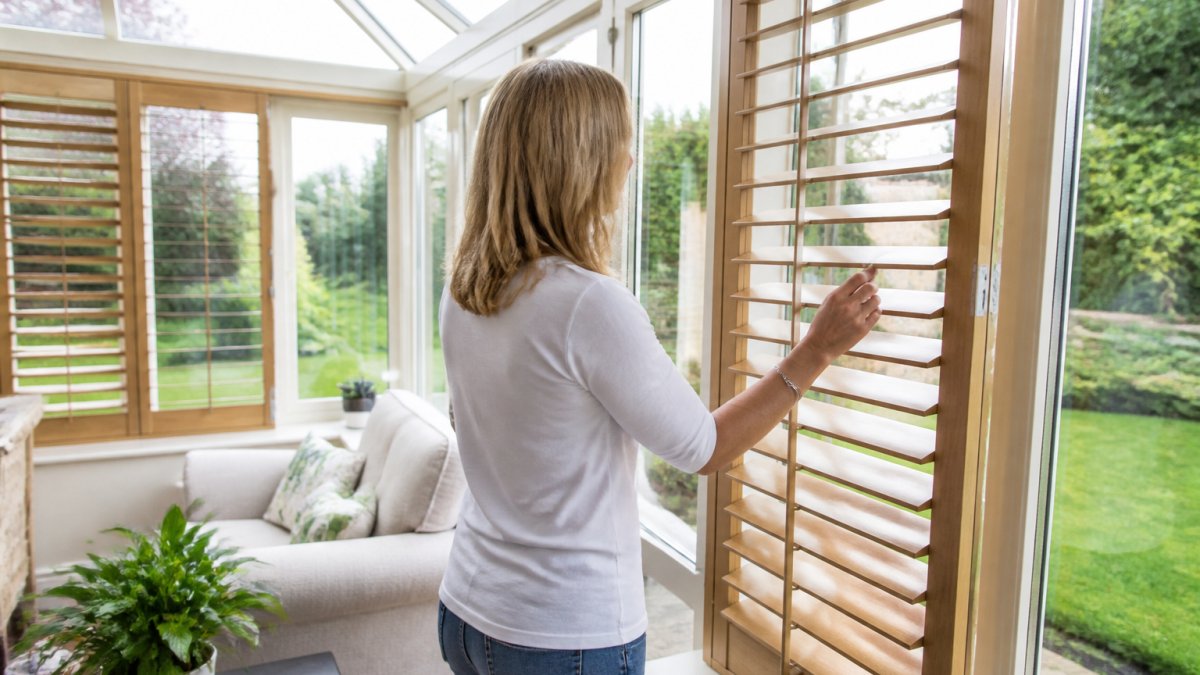
Side Windows, Roof Glazing and Doors
Side windows are the easy win: a hinged or café-style panel closes the sightline completely when shut.
Doors need more thought. Patio and French doors carry the most traffic, so choose a panel that folds flat against the frame and clears the floor.
Roof glazing is where most conservatories lose their privacy. Shutters can be fitted to roof lights, but the weight and angle need proper brackets.
Conservatory Shutters for Light Control and Year-Round Comfort
Conservatory shutters for light control do two jobs at once: they cut glare on a bright day and hold warmth in during winter. A conservatory overheats in July and turns cold by November; shutters soften both ends of that swing.
The louvre is the mechanism. Tilt it and you change how much sun lands on the sofa, the floor, and your face.
Louvre Angles That Keep Daylight but Cut Glare
Set louvres roughly horizontal to keep the view and most of the daylight. Tilt them up towards 45 degrees to block the low sun that causes screen glare while soft light bounces off the ceiling.
- Morning sun on an east side: louvres angled up, panels shut.
- Low winter sun: louvres near-horizontal to let warmth in.
- Midday summer glare: louvres tilted down to throw light at the floor.
Close the roof-facing louvres first on a hot day, before the side panels. The roof is where most heat enters, so blocking it early keeps the room cooler for longer than fighting the side glare later.
Shutter Styles and Louvre Options for Conservatories
Full-height panels suit tall conservatory windows and give the cleanest line. Café-style panels cover the bottom half only, keeping the top clear for daylight and views. Tier-on-tier splits the window into two independent sections, so you can shut the bottom for privacy and leave the top open. Roof panels need their own brackets and angle.
| Style | Best for | Privacy level | Daylight kept |
|---|---|---|---|
| Full-height | Tall side windows | High | Medium |
| Café-style | Overlooked lower panes | Medium | High |
| Tier-on-tier | Mixed use, day and night | Adjustable | Adjustable |
| Roof panels | Overlooked roof glazing | High | Low to medium |
Louvre Width: What It Changes in Practice
Louvre width matters more than most people expect. Wider louvres give a better view when open and a cleaner line when closed. Narrower louvres give finer light control and a more traditional look, but take more machining and slats per panel, affecting price and weight.
A practical rule: for a view you want to keep, favour a wider louvre so the open position is as clear as possible.
Conservatory-Specific Constraints
A conservatory is a harsher environment for any window covering than a standard room, and the style choice has to account for that:
- Condensation and humidity: glass-heavy rooms swing between warm and cold, and moisture collects on cold surfaces. Timber shutters need a finish that seals the edges, and panels should stand slightly proud of the glass so air can move behind them. Ask how the finish handles the humidity swing before choosing a painted option.
- Frame compatibility: conservatory frames are often uPVC, aluminium or timber, and each takes fixings differently. A hollow uPVC section will not hold a heavy panel safely, so the frame has to be assessed before a fixing method is chosen. No-drill or clip-fit frames help on smaller side windows; proper brackets are non-negotiable on roof glazing.
- Thermal movement: frames and panels expand and contract at different rates through the year. A snug fit with a small allowance beats a tight fit that binds in summer; a supplier who templates the opening will build that allowance in.
Do not choose a style from a photograph alone. The frame type, the angle of the glazing and the humidity swing in your conservatory all affect which style will fit and last. Ask for the frame to be assessed before the style is confirmed.
If you want to keep the view on an open-garden side but still want privacy at night, choose a tier-on-tier or café-style panel with a wider louvre. You get a clear open position by day and a full close at night without paying for full-height panels on a window nobody overlooks.
Shutters for Shaped Conservatory Windows and Awkward Angles
Shutters for shaped conservatory windows are made from a template of your actual opening, not a standard size, the whole point of bespoke.
This is where cheap options fail. A rectangular blind fitted to a triangular gable leaves a wedge of exposed glass, and that wedge is usually the bit facing next door.
We template shaped openings on site, then build the frame to match. Expect a snug fit with no filler strips and no draughts.
If a supplier quotes you from a photograph or a rough sketch, walk away. Shaped conservatory glass needs a physical template. Anything less and you will live with gaps.
Your Conservatory Shutter Measuring Guide
Measure each pane separately, even if two look identical. Conservatory frames settle, and a few millimetres of difference is normal. Use a metal tape, not a fabric one.
- Measure the width at the top, middle, and bottom of the recess. Note the smallest figure.
- Measure the height at the left, centre, and right. Note the smallest figure.
- Measure the depth of the recess so the frame clears handles and seals.
- Sketch each window and number it, so the fitter knows which panel goes where.
- Photograph each window with the tape in shot.
No-Drill and Clip-Fit Options
No-drill installation uses a tension or clip-fit frame that holds without screws into the uPVC, suiting rented homes and frames you would rather not pierce. The trade-off is weight: large panels need proper fixing, so clip-fit works best on smaller side windows and café panels.
We assess the frame first. A tired seal or a hollow uPVC section will not hold a clip-fit panel safely, and we will tell you before you order.
Made-to-Measure Conservatory Shutters: Costs, Lead Times and Alternatives
Made-to-measure conservatory shutters are priced per panel, so the total depends on how many openings you have, how many are shaped, the louvre size and the timber or finish. No single figure fits every conservatory, and any supplier who quotes one without measuring is guessing.
What Drives a Bespoke Quote
Separate the fixed and variable parts of a quote:
- Panel count and size: each panel is priced individually, so a three-sided conservatory with eight openings costs more than a two-sided one with four, even at the same rate per panel.
- Shaped openings: gable ends, arched tops and angled corner panes need a physical template and a custom frame, adding labour and machining time compared with a straight rectangle.
- Louvre size: narrower louvres take more machining and more slats per panel, so they usually carry a higher unit price than wide louvres.
Because of these variables, a sensible quote is built after a home visit, not from a photograph. Ask for it broken down by opening so you can see which windows drive the total and where to trim, for example, leaving an open-garden side clear and spending on the overlooked panes instead.
Lead Times
Lead times vary with the number of shaped panels and the finish:
- Straight rectangular panels in a standard finish are quickest to produce.
- Painted or sprayed finishes add a production stage and therefore time.
- Templated gable ends, arches and angled corner panes take longest, because the template must be taken, checked and matched to the frame before machining.
Ask your supplier to confirm the lead time in writing against your panel list and to flag which panels are on the critical path. A supplier who cannot give a dated schedule before you pay a deposit is a warning sign.
Shutters Compared With Alternatives
| Option | Privacy | Light control | Appearance | Maintenance | Suitability for conservatory glazing |
|---|---|---|---|---|---|
| Bespoke shutters | High, panels close the sightline completely | Fine, louvres tilt to any angle | Fitted furniture look; hides frame gaps | Dust with a dry cloth; occasional wipe | Made to the opening, including shaped and roof glazing |
| Roller and vertical blinds | Medium, gaps at edges and top | Coarse, open or closed | Can look dated; stacks at the head | Spot-clean; fabric can sag | Standard widths rarely match angled panes |
| Curtains | Medium to high when closed | Coarse, blocks the view when drawn | Softens the room; can crowd a glass-heavy space | Regular laundering; can trap humidity | Awkward on angled and roof glazing |
| Privacy film | High by day, lower at night when lights are on | None, fixed | Can look flat; edges lift in heat | Wipe clean; can bubble over time | Works on flat glass; difficult on shaped panes |
Shutters cost more upfront than blinds or film, but they are fitted to the millimetre, close the gaps the others leave, and are built to last. Film is the cheapest quick fix but blocks the view both ways and can bubble in a hot conservatory; blinds are cheaper but need replacing sooner and rarely suit shaped glazing.
Government guidance on protecting your home from overlooking
Ask for a per-opening quote and a dated lead-time schedule before you pay a deposit. That single request separates a genuine bespoke supplier from one who is guessing.
Conclusion
Getting privacy right in a conservatory is a measuring job before it is a buying job. Walk your sightlines, treat each window differently, and insist on a template for anything shaped.
At Wooden Shutters, we bring the design to your home: a free consultation with no pressure, panels made to your exact dimensions from sustainably sourced timber, and expert fitting by our own team.
Book a free home visit with Wooden Shutters and get shutters that fit your conservatory, not the other way round.
Frequently Asked Questions
How can conservatory shutters provide privacy without blocking all the light?
Tilting the louvres rather than closing the panels is the key. A partial tilt, roughly 30 to 45 degrees, blocks the direct line of sight from outside while still letting daylight bounce off the slats and into the room. On side windows facing a neighbour, angle the louvres upward; on roof glazing, a shallower tilt cuts glare without darkening the space. Because each panel adjusts independently, you can keep the garden view through one window and close down the one that faces the road.
How do you measure conservatory windows for made-to-measure shutters?
Measure the width at the top, middle and bottom of the recess and the height at the left, middle and right, then use the smallest figure for each. For a recess fit, measure inside the reveal; for an outside fit, measure the frame face and add the overlap you want. Note any handles, window vents or sloping reveals, and photograph each window with a tape measure in shot. Angled bay and shaped windows are best templated by a fitter, so ask for a free home visit before ordering.
Can shutters be made to fit conservatory windows of unusual shapes?
Yes. Shaped conservatory windows, including angled gable ends, arched tops, sloping roof lights and angled bay returns, can be templated and built to the exact profile. The panel is cut to follow the frame, and the louvres are set within that shape so there are no wedge-shaped gaps at the edges. Awkward angles are the main reason off-the-shelf blinds fail in conservatories, so a made-to-measure survey is worth arranging early.
Are bespoke conservatory shutters suitable for rooms that get hot or cold?
They help with both. Closing the panels and tilting the louvres creates a layer of still air between the shutter and the glass, which slows heat loss on cold evenings and reduces solar gain on bright afternoons. Solid-wood and hardwood shutters hold their shape through the temperature swings a conservatory sees, unlike lightweight blinds that can warp or fade. Pair them with ventilation and you get a room that stays usable for more of the year.