
Last Updated: November 17, 2026
Quick Summary
The best shutters for privacy and light are tier-on-tier and café-style styles, which let you control the top and bottom of a window separately. For most rooms, tilt louvres to roughly 45 degrees upward by day to bounce daylight off the ceiling while blocking the eye-level view, then close them fully at night.
- Café-style shutters cover only the lower half of a window, leaving the top clear for full daylight.
- Tier-on-tier shutters split the window into two independent sections for the most flexible control we fit.
- A 47mm louvre gives finer control with more slats per panel and narrower gaps.
- Solid panel shutters block light far more than louvred styles, suiting light sleepers and street-facing rooms.
- Bay windows need each angled panel measured and cut separately so shutters follow the shape without gaps.
Table of Contents
- Shutter Styles Compared: Light Control and Privacy at a Glance
- How Louvre Size and Slat Angle Decide Your Sightlines
- Café-Style Shutters for Lower-Window Privacy
- Tier-on-Tier Shutters: Independent Panels, Flexible Control
- Plantation Shutters for Privacy Without Losing Daylight
- Plantation Shutters vs Solid Panel Shutters for bedrooms
- Measuring and Choosing for Bay, Full-Height and Awkward Windows
- Book a Free Home Visit to Match Shutters to Your Windows
- Frequently Asked Questions
Shutter Styles Compared: Light Control and Privacy at a Glance
Choosing the best shutters for privacy and light comes down to one thing: how much control you want over your sightlines. At Wooden Shutters, we fit made-to-measure wooden shutters, and the pattern is always the same. The right style depends on your window shape, which way it faces, and how overlooked you are.
Shutters are window coverings built from hinged panels holding adjustable horizontal slats, called louvres, that tilt to manage daylight and privacy at the same time. Unlike a roller blind, which is either up or down, shutters let you fine-tune light entry and sightlines without losing the window completely.
Here is how the main styles compare before we go into detail.
| Style | Light Control | Privacy | Ventilation | Relative Cost | Best For |
|---|---|---|---|---|---|
| Café-style | Lower half only; top stays clear | Strong at street level, weak above | Lower panels tilt while top stays open | Lowest of the four | Living rooms, kitchens, period sash windows |
| Tier-on-tier | Top and bottom independently | Flexible, room by room | Upper tier tilts for airflow with lower closed | Mid to high | Bay windows, bedrooms, tall windows |
| Plantation, full-height | Full window, adjustable slats | Good, with night limits | Slats tilt for airflow without opening the panel | Mid | Most rooms, full-height and French doors |
| Solid panel | High, blocks light | Highest | None through the panel | Highest | Bedrooms, light sleepers, street lamps |
The trade-off is simple. More slats and smaller louvres give finer control. Larger louvres let in more daylight but leave wider sightlines when tilted open. Pricing depends on the window, the style and the number of panels, so the best next step is to request a quote for each room from our website.
A useful way to decide is to score each window on four questions: how overlooked it is at eye level, how much daylight you need, whether you want ventilation with privacy, and how dark the room must go at night. A street-facing living room usually scores high on overlooking and daylight but low on darkness, which points to café-style or tier-on-tier. A back bedroom scores high on darkness and low on daylight, which points to solid panel or plantation with a blackout lining.
How Louvre Size and Slat Angle Decide Your Sightlines
Louvre size is the single biggest factor in privacy and light balance, and it is the detail most guides skip. A 64mm louvre gives a cleaner, more traditional look with fewer, wider slats. An 89mm louvre lets more daylight through per slat but leaves a larger gap when open. A 47mm louvre sits at the fine-control end, with more slats per panel and narrower gaps.
Slat angle does the rest, and the geometry matters more than most people realise. Tilted fully closed, louvres block most of the view in and out, which matters for street-facing windows and overlooked gardens. Tilted flat, you get maximum daylight but almost no privacy. The sweet spot for most rooms sits somewhere in between, angled up slightly so daylight bounces off the ceiling while the view at eye level stays blocked.
Sightlines are not fixed; they change with the time of day and the light on either side of the glass. During daylight, the brighter side is outside, so a passer-by looking in sees mostly reflection and the room reads as dark. After dark, the balance flips: with a room lit and the street unlit, anyone outside can see in through gaps that were invisible at noon. That is why a slat angle that feels private at 3pm can feel exposed at 9pm.
A practical day-versus-night routine helps. By day, tilt louvres to roughly 45 degrees upward to bounce light off the ceiling while cutting the eye-level view. By night, close the louvres fully in rooms that face the street or a neighbour, and rely on a second light source deeper in the room rather than a lamp beside the window, which silhouettes anyone near the glass.
Louvre width changes the trade-off. Wider 89mm louvres admit more daylight per slat but, when tilted open, present a taller gap that a viewer at a distance can see through. Narrower 47mm or 64mm louvres give finer increments, which suits low windows onto a pavement where head height matters. A common mistake is choosing the widest louvre for a low window onto a pavement. Wider slats look generous, but at head height they leave sightlines you cannot close without shutting out all the light.
Watch out: louvre tilt only controls the direct view. At night, light spilling through the edges of the panel and around the frame can still reveal movement inside, so pair tilt control with a close-fitting made-to-measure frame if the room is overlooked after dark.
Café-Style Shutters for Lower-Window Privacy
Café-style shutters cover only the lower half of a window, leaving the top clear. That makes them a strong pick for street-facing living rooms and kitchens where you want privacy from passers-by at eye level without darkening the room.
The top half stays open to full daylight, while the lower panels give you privacy control exactly where you need it. For period homes and sash windows, café-style panels keep the proportions of the window intact. If you want to see the full range of options, you can explore café-style window shutters on our site.
Best for: ground-floor rooms overlooked from the street.
Skip if: you need privacy across the whole window at night.
Tier-on-Tier Shutters: Independent Panels, Flexible Control
Tier-on-tier shutters split the window into two independent sections, so you can open the top panels for daylight while the bottom stays closed for privacy. This is the most flexible configuration we fit, and it suits tall windows and bay windows especially well.
You get top and bottom control in one window: close the lower tier in the evening, leave the upper tier tilted open for light. It is a practical answer to the privacy and light question, because you are not forced to choose one for the whole window. See the tier-on-tier window shutters range to compare panel layouts.
Best for: tall windows and rooms used differently through the day.
Skip if: you have a small window where two tiers add little.
Plantation Shutters for Privacy Without Losing Daylight
Plantation shutters are a popular full-window option. Adjustable louvres give precise control over daylight while keeping a clean, timeless look that suits both modern and traditional interiors.
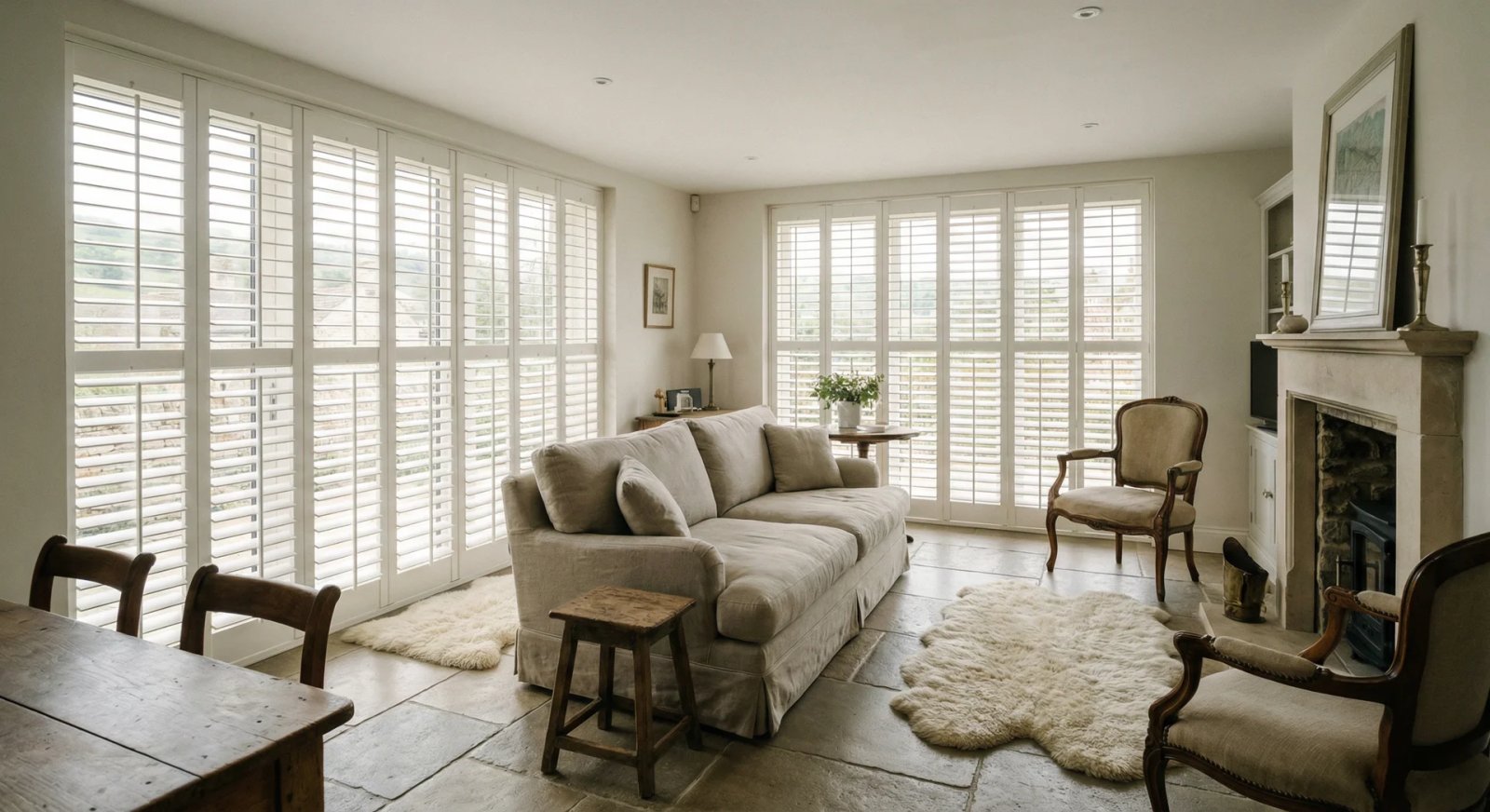
The key advantage is light filtering rather than light blocking. Tilt the louvres to let daylight in while cutting the view from outside, so a room stays bright without feeling exposed. Made-to-measure panels are cut to fit your window.
One honest limit: with the louvres fully closed, plantation shutters still let a sliver of light through at the edges. For most living rooms that is fine. For a bedroom where you want near-total darkness, a solid panel or a blackout lining behind the shutter works better.
Plantation Shutters vs Solid Panel Shutters for bedrooms
For bedrooms, the choice usually comes down to plantation shutters versus solid panel shutters, and the deciding factor is how dark you want the room. Solid panel shutters block light far more than louvred styles, which suits light sleepers and rooms facing a street lamp.
Plantation shutters win on flexibility. You keep daylight control during the day and a reasonable level of privacy at night, and the room feels less closed in. The trade-off is that a small amount of light still gets through when the louvres are shut.
Our rule of thumb: if you wake with the sun or need a dark room, go solid panel. If you want a bright, airy bedroom that still feels private, plantation is the better fit. Both can be made to match your window shape and interior style.
Measuring and Choosing for Bay, Full-Height and Awkward Windows
Bay windows, full-height windows and non-standard shapes need made-to-measure shutters, because off-the-shelf options leave gaps at the angles. This is where custom fit matters most.
For bay windows, each angled panel is measured and cut separately so the shutters follow the shape of the bay without gaps. Full-height shutters run the whole window, giving maximum window coverage and a clean line from floor to ceiling. For arched or awkward shapes, bespoke panels are shaped to the frame. We cover this in more depth in our guide on how to fit shutters to awkward window shapes, and you can see bespoke bay window shutters for angled layouts.
A common mistake is measuring the recess rather than the window opening. Get that wrong and the panels bind or leave light gaps.
Book a Free Home Visit to Match Shutters to Your Windows
The fastest way to get the right shutters for privacy and light is to have them matched to your actual windows in person. Our free home visit lets us talk through shutter options with you in your own home.
There is no pressure and no obligation. We are a family-owned Derbyshire business, we source sustainably, and we combine traditional skills with modern technology. You can read how to book a shutter consultation at home to see exactly how the visit works before you commit.
Getting privacy and light right is about matching the style to each window, not picking one shutter for the whole house. Wooden Shutters can measure, advise and fit made-to-measure wooden shutters tailored to your rooms, with a free home consultation, sustainable sourcing and professional installation. Get started with Wooden Shutters and book a free home visit to match shutters to your windows.
Frequently Asked Questions
Which shutters are best for privacy and light control?
Plantation shutters with adjustable louvres give fine control: tilt the slats part-open and you keep daylight while blocking direct sightlines from the street. For lower windows, café-style shutters cover the bottom half only, so the top stays clear. Tier-on-tier shutters add independent top and bottom panels, which suits tall windows where you want privacy at eye level and light above. The right choice depends on window height, aspect and how overlooked you are.
Do plantation shutters provide privacy while letting in light?
Yes, when the louvres are angled rather than fully closed. A part-open slat angle lets daylight bounce off the ceiling while cutting the direct line of sight from outside. At night, with a room light on, the effect reverses and silhouettes can be visible, so close the slats fully after dark. Plantation shutters for privacy work best alongside a lamp rather than a bright overhead light in overlooked rooms.
Are tier-on-tier shutters better for privacy?
They offer flexible privacy. Tier-on-tier shutters have separate top and bottom panels on the same frame, so you can close the lower section for street-level privacy and leave the upper louvres open for daylight. That makes them a strong choice for tall sash or Georgian windows.
Can you see through shutters when the louvres are closed?
With quality shutters, closed louvres overlap and leave only hairline gaps, so you cannot make out detail from outside. Thinner slats can bow and leave wider gaps at the edges. Check the frame has a rebated stop and the panels sit flush. If total blackout matters, a solid panel may suit better than closed louvres alone.
Are full-height or café-style shutters better for privacy?
Full-height covers the whole window and gives the most consistent privacy, which suits bedrooms and street-facing rooms. Café-style shutters cover only the lower half, so passers-by cannot see in at seating height while the top of the window stays open for daylight. For a living room on a pavement, café-style is often enough. For a bedroom, full-height is the safer choice.
